Cyber security publicity week is hot. Let’s see how to "zoom in"

  China Youth Network Beijing, September 22nd.(Reporter Yang Qingshan) On the morning of the 19th, the opening ceremony of the 2016 National Cyber Security Publicity Week was held in Wuhan, Hubei Province. The cyber security week was held on September 19th — — On the 25th, the theme was "Network security is for the people, and network security depends on the people". Around the theme of this cybersecurity week, various localities have organized related activities and exhibitions and "released big tricks" to increase public participation and push the popularity of cybersecurity publicity week to a climax.

  Wuhan, Hubei Province: Many activities go hand in hand, and the host "fights"

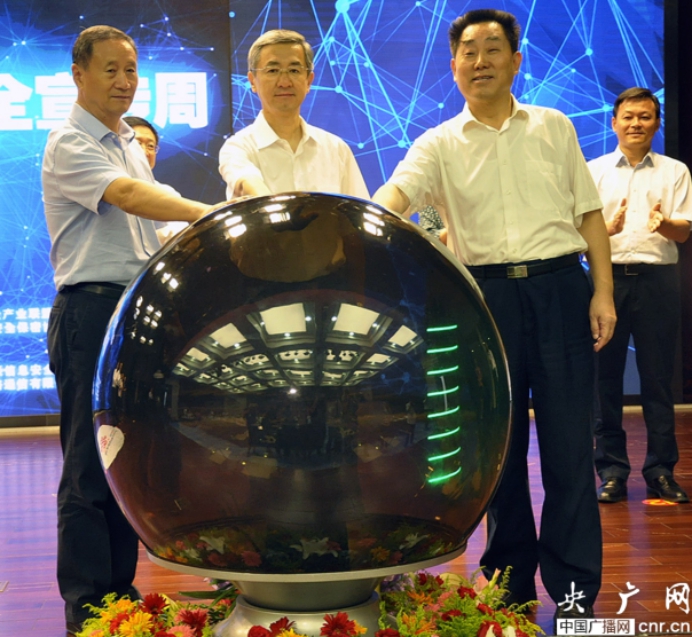
  As the host of this cyber security week, Wuhan organized personnel from various industries and carried out a number of activities, leading the first wave of publicity week.

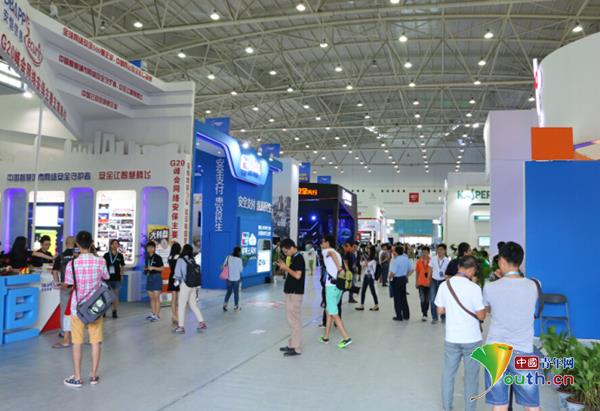
  On September 19th, as one of the key activities of the National Cyber Security Publicity Week in 2016, the Cyber Security Expo was held in Hall A6-1 of Wuhan International Expo Center. There are 95 companies in the field of network security participating in the exhibition, and the number of participating companies and the scale of the exhibition area are the highest in history. The Expo embodies the public’s sense of ownership of network security. Everyone is the responsible subject of network security, and personal network security is closely related to national network security.

  Cyber Security Expo September 19th — It was held at Wuhan International Expo Center on 25th. China Youth Network reporter Yang Qingshan photo

  At the same time, Wuhan held a number of cybersecurity-related forums, including the Technology Summit Forum, the Cyber Security Talent Training and Innovation and Entrepreneurship Forum, and the Big Data Security Technology and Practice Forum. Invite many experts in network security technology from all over the world, train excellent teachers with network security talents, and talk about the current situation and prospect of network security.

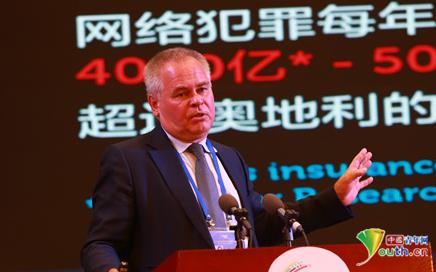
  On September 19th, Eugene Kaspersky, CEO of Kaspersky Company, gave a speech at the Technology Summit Forum. China Youth Network reporter Yang Qingshan photo

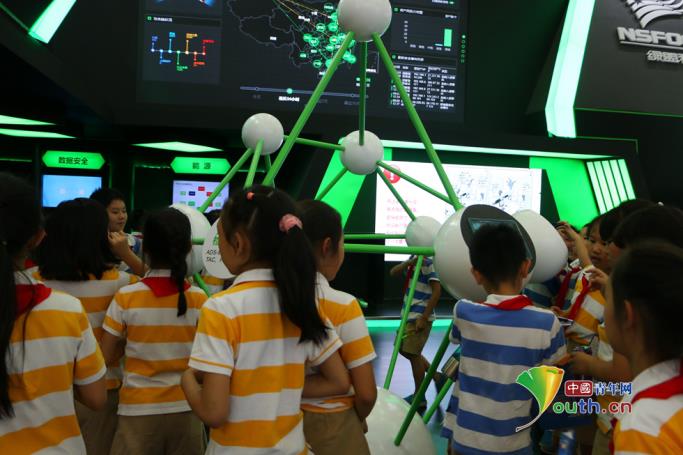
  On September 20th, 2016 National Cyber Security Publicity Week entered the "Education Day". The Hubei Provincial Department of Education and the Wuhan Municipal Education Bureau organized more than 10,000 primary and secondary school students to visit the Cyber Security Expo at the International Convention and Exhibition Center, and experienced the grand occasion of the publicity week on the spot, turning the main venue into the second classroom to perceive and experience cyber security.

  Sichuan: Network Security Knowledge Competition "Into the Mind"

  Since the official launch of the 2016 National Cyber Security Publicity Week in Sichuan and Chengdu on the 19th, various cities and states in Sichuan have successively held a series of themed activities, which are colorful, interesting, popular and numerous, and deeply loved by local citizens.

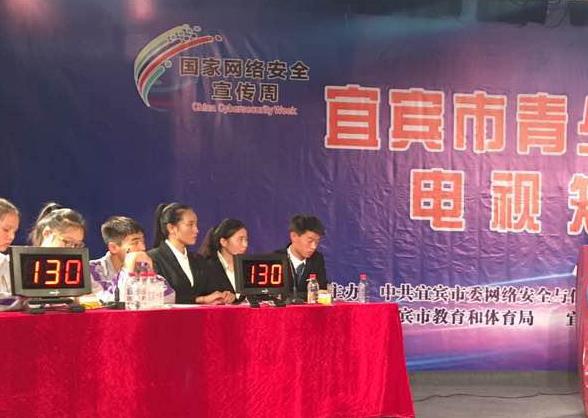
  Yibin City held the "Yibin Youth Cyber Security TV Knowledge Competition Finals", Luzhou Broadcasting Network teamed up with Luzhou News Broadcasting to carry out the audio-visual special program of National Cyber Security Publicity Week, and Meishan City carried out cyber security knowledge into the campus and other activities.

  Henan: offensive and defensive drills+intuitive experience of skill competition

  At present, there are more than 70 million netizens in Henan Province, and the number of websites is close to 240,000. The task of maintaining network security is very arduous. The purpose of launching this "Cyber Security Publicity Week" is to cultivate the cyber security awareness of netizens, improve their ability to identify and prevent harmful information on the Internet, promote the formation of a good environment for building a cyber security defense line, and provide a strong guarantee for building a network province.

  During the publicity week, Henan organized publicity and education, knowledge lectures, online knowledge contests, product demonstrations, offensive and defensive drills, skill competitions and other activities. Through a variety of activities and vivid case presentations, the awareness of cyber security of the majority of netizens was enhanced, and a good atmosphere for all people to participate in maintaining cyber security was created. Henan Province will also strengthen the construction of network security infrastructure and comprehensively improve the level of network security management and protection.

  Shanxi: Information Security Summit Forum "Building a Defense Line"

  According to the monitoring data of Shanxi Internet Emergency Center, in 2015, a total of 551 websites of party and government organs and important information systems in Shanxi Province were tampered with, attacked or implanted into the back door, and more than 450,000 hosts were controlled by hackers because of being infected with zombie Trojans. The number of mobile phone users infected with malicious programs on the mobile Internet reached more than 10 million, and 3% of netizens’ hosts were controlled by Trojan virus.

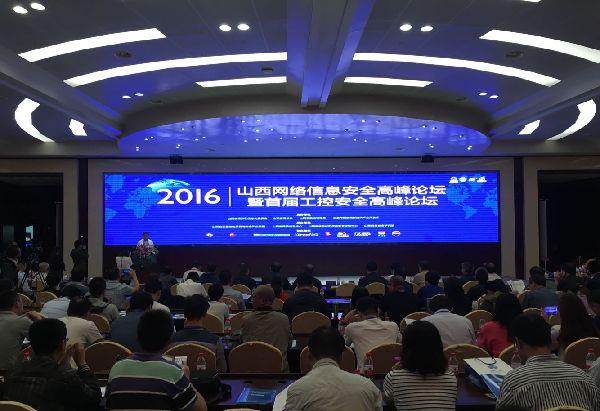
  On September 20th, Shanxi held the 2016 Shanxi Network Information Security Summit Forum and the first Industrial Control Security Summit Forum with the theme of "Building Key Information Infrastructure Security Defense Line Together". At the forum, national network information security experts and domestic excellent security vendors exchanged and contributed security wisdom and the latest research results. Experts attending the meeting said that only by doing a good job in ensuring the basic network security can we better help the economy and society to leapfrog development. Only by protecting the safety of every netizen can network security take root and build a solid Great Wall of network security with solid bricks and tiles.

  Chongqing: Go into the school community and interpret the things around you with practical cases.

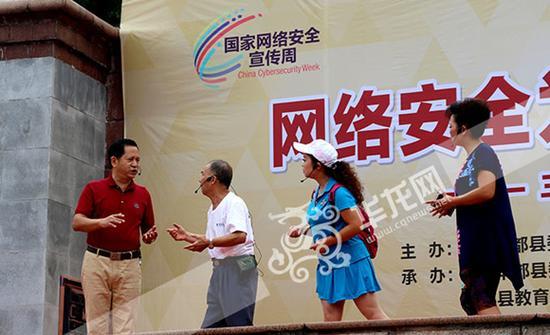
  With the opening of Chongqing Cyber Security Publicity Week in 2016, all districts and counties have begun to "enlarge their tricks" and launched various cyber security publicity and popular science activities in densely populated areas such as communities, enterprises, schools and stations, so that citizens can build security "firewalls".

  Among them, Banan District continued to carry out network security publicity and service activities in farms, communities, schools, enterprises and business districts, and printed 15,000 network security publicity materials to fully popularize network security knowledge. Enter the farm to provide villagers with a home computer security maintenance; Enter the community to provide residents with a home router security maintenance; Enter the school and offer a special lecture on network security for students; Enter the enterprise and provide a system network security detection and maintenance for the enterprise; Into the business circle, for the public to carry out a network security publicity and exhibition.

  Gansu: firmly grasp the youth group

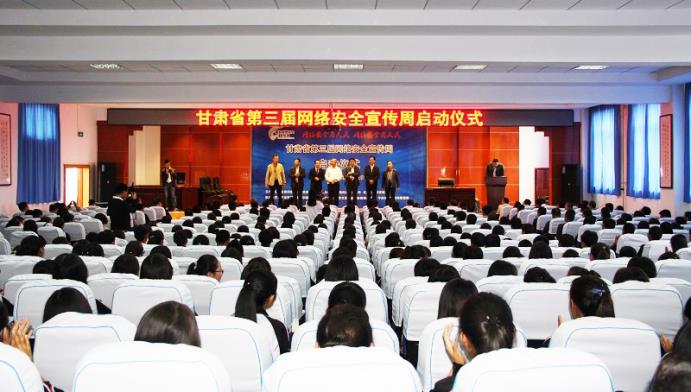
  On September 19th, the launching ceremony of the 3rd Cyber Security Publicity Week in Gansu Province was held in Gansu Medical College.

  Wang Guoqiang, deputy director of the Network Information Office of Gansu Provincial Party Committee, stressed that it is necessary to mobilize all social forces, devote themselves to various publicity with a high sense of responsibility and urgency, and strive to hold a wonderful and pragmatic publicity week. It is necessary to carefully organize and improve the quality of activities, and carefully organize their own activities around the theme of publicity week, combined with the actual situation of the industry. It is necessary to highlight key points, firmly grasp youth groups, do a good job in school activities at all levels, and guide young people to enhance their awareness of network security and develop good network behavior habits; It is necessary to mobilize widely, publicize in all directions through websites, newspapers, TV stations, conferences and exhibitions, etc., mobilize the enthusiasm of the majority of netizens, truly make network security deeply rooted in the hearts of the people, expand and extend, and vigorously promote the normalization, institutionalization and long-term publicity of network security.

  Jilin: Popularizing network fraud prevention knowledge in various forms.

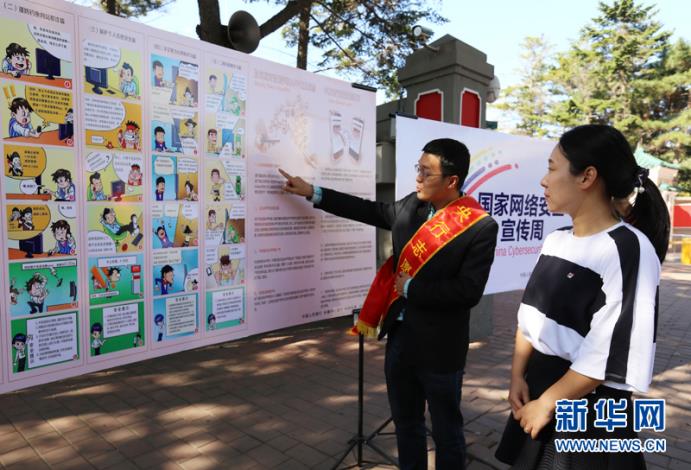
  In 2016, Jilin Cyber Security Publicity Week was launched. At the event site, the staff explained the relevant knowledge of network security to the past citizens. Image source: Xinhuanet

  On September 19th, the "Jilin Cyber Security Publicity Week" sponsored by the Network Information Office of Jilin Provincial Party Committee was held in Changchun. At the event site, nearly 100 banners with the words "network security propaganda" and "more network protection skills, more information security guarantee" and more than 100 illustrated network security propaganda exhibition boards attracted passers-by to stop and watch. At the same time, the free distribution of all kinds of online fraud cases and anti-fraud information in the publicity knowledge manual by on-site volunteers is also particularly concerned by the elderly.

  The people at the scene said that the publicity campaign popularized knowledge to the public through various forms, which can make people understand the knowledge related to network security more intuitively and prevent being deceived.

Changzhi actively builds a standardized construction system, and rural boarding schools are warm and at home.

  ■ A magnificent 70-year struggle, a new era, and educational endeavor.

  The canteen with bright kitchen, flush toilet, hot bath, weekly washing, 24-hour boiling water, and dormitory "water heating and electric heating" are guaranteed … … In the past, such conditions were almost extravagant for children in rural schools, but today, extravagant hopes have become a reality in rural boarding schools in Changzhi City, Shanxi Province.

  In recent years, Changzhi City has actively built a standardized construction system for rural compulsory education boarding schools, and established an operating mechanism with rules to follow. From 2017 to 2018, the city invested a total of 437 million yuan to complete the task of standardizing the construction of 381 rural boarding schools, and achieved the comprehensive standard of six facilities of food, accommodation, toilet, washing, drinking and heating in rural schools in the city, and a number of boarding schools with their own characteristics emerged.

  In May 2018, at the press conference held by the Ministry of Education to interpret the Guiding Opinions of the General Office of the State Council on Strengthening the Construction of Small-scale Rural Schools and Township Boarding Schools in an All-round Way, Changzhi Education Bureau, as the only representative of cities in China, exchanged experiences, and Changzhi became a typical rural boarding school construction in China.

  The dormitory is warm, the food is fragrant, and the poetry is long.

  The sun shines into the room through the bright window, the quilt is folded with edges and corners, the sheets are laid flat, and the towels are in a line … … Walking into the dormitory of Baichi Mingde School in Huguan County, I feel the neatness of barracks and the warmth of home.

  At the beginning of the standardization construction of rural boarding schools, Changzhi City first targeted at the "fragmentation" problems such as multi-disciplinary tasks overlapping and multi-head management in the original standardization construction management system, integrated and reorganized the functions of basic education, finance and equipment centers related to standardization construction, set up a municipal student service management center, and approved the establishment of six people to be responsible for the standardization construction of rural compulsory education boarding schools. In 2017, all the special management institutions were improved at the city and county levels, and posts, people and responsibilities were fixed. At the same time, the "Standards for Toilets, Drinking Water, Bathing and Heating in Rural Compulsory Education Schools in Changzhi City" was issued, which clarified the standards in terms of building layout, equipment and facilities, health management and safety management. The management methods of school dormitories and the standardized management manual of student dormitories were issued, which provided the basis and standard for the construction of boarding schools.

  In order to ensure that students in boarding schools eat well and eat safely, Changzhi City has set strict access standards for "two personnel" and "two thresholds" for bulk food procurement, and jointly issued the Access System for School Canteen Service Personnel and Apartment Management Personnel and the List of Enterprises Recommended by Bidding for Rural Compulsory Education Schools with the Food and Drug Administration and CDC. By means of "written test+skill test+physical examination+certificate access", 2,143 qualified personnel were recruited and 738 unqualified personnel were retired. By adopting the method of "theoretical training+practical operation+skill evaluation+issuing grade certificates", everyone has been certified to work. 88 food enterprises were inspected and 40 were selected by means of public inspection and bidding; Twelve catering service enterprises were inspected, and nine were selected, and all the audited qualified food enterprises, catering enterprises and "two-member" directories were entered into the electronic management platform of student service, which realized the openness and transparency of food bidding, enterprise access and personnel recruitment.

  Baichi Mingde School, located in Baichi Town, Huguan County, is a nine-year compulsory school in rural areas. Baichi Mingde School refines the relevant regulations of Changzhi City into "678" management system in canteen management, and "6" means six ones: "Don’t repeat the sample every day of the week, add a little for three meals a day, one or two meats a day, one egg a day, one bag of milk a day and one fruit a day"; "7" means "7 passes" for purchasing, warehousing, storage, warehousing, processing, sample retention and disinfection; "8" means that eight kinds of ingredients, such as non-supplied ingredients, three no, expired and moldy, are not allowed to enter the restaurant. The reporter noted that the standardization of catering, food safety, standardized management and balanced nutrition have become the normal management of the dining halls in Changzhi boarding schools.

  "mountains cover the white sun, and oceans drain the golden river, but you widen your view three hundred miles, by going up one flight of stairs" … … Every morning and afternoon during recess exercises, more than 1,300 teachers and students of the whole school recite ancient poems to the beat of music on the playground. The scene is spectacular. In order to carry forward the excellent Chinese traditional culture, Baichi Mingde School has compiled 600 ancient poems into six sets of rhythmic exercises, each with 100 poems. The combination of chanting poems and doing exercises has really played a role in fitness and heart-building.

  "We must not only let the children in the village eat well and live well, but also let the children learn well and receive a better education." Li Jianqing, the principal of the school, introduced that the school has also implemented the weekend parents’ public lectures system, which allows parents to participate in the classroom, pay attention to their children’s growth, make specific suggestions, and promote the continuous improvement of teaching quality.

  In recent years, more and more parents around have chosen Baichi Mingde School. When the school first enrolled students, there were only 260 students and 7 classes. Now there are 1349 students and 30 classes. Baichi Mingde School has become a "good school" repeatedly praised by local parents, and its teaching quality has ranked first in the county for 10 consecutive years. In 2013, it won the "National Advanced Collective of Education System".

  On the pitch, in class, teenagers are busy chasing dreams.

  Emergency stop, dribbling, passing, shooting … … When the reporter came to the primary school in Weizi Town, Lucheng District, it was during the break time. A group of boys were playing football on the clean and tidy green plastic playground, defending and attacking, and playing well.

  Weak physical education teaching is a common problem in schools at present. In order to make up for the shortcomings, Changzhi City clearly stipulates that all schools should open their schools in physical education class. Physical education and health courses should be held for four hours a week in the first and second grades of primary schools, three hours a week in the third to sixth grades and junior high schools, and two hours a week in senior high schools. It is strictly forbidden to crowd out, so as to ensure that every student can master at least one sports skill. Moreover, in order to give full play to the guiding role of senior high school entrance examination in strengthening students’ physical exercise, Changzhi City adjusted the policy of senior high school entrance examination, and adjusted the sports score of senior high school entrance examination from 50 to 70, which effectively promoted the development of school sports activities.

  In recent years, with the continuous efforts of the state in campus football work and the great improvement of the conditions for running boarding schools in rural areas, more and more schools in Changzhi City regard football as the first choice for sports activities, and more and more students fall in love with football. "Campus Football" is a characteristic project of Weizi Town Primary School in Lucheng District, and is listed as a compulsory course. In 2016, the school established a school football team and a class football team above grade three, and actively promoted the "one-day routine" and implemented a class league, with remarkable results.

  The enrollment scope of Weizi Town Primary School includes 28 natural villages in the town. At present, there are 478 students and 16 teaching classes. The national regulations provide comprehensive courses, and more than 10 elective courses such as vocal music, instrumental music, dance, calligraphy, painting, 3D printing, robotics and chess are offered.

  "It is no longer the extravagant hope of peasant children to enjoy fair and quality education, and the characteristic projects of rural boarding schools are constantly presented, so that rural education can achieve better and faster development." Shi Xiaowen, the principal of the school, said that the school is vigorously developing new courses, building new classrooms, and constructing a basic model of cooperative learning classroom teaching with "self-study moving forward and display as the mainstay". In the third grade, the school introduced e-books and tried smart classroom experiments. From grade one to grade six, the Chinese subject learning experiment was introduced to completely change the traditional Chinese classroom teaching mode.

  In Changzhi, "implementing the reconstruction project of stadiums and facilities in primary and secondary schools" is included in the government’s practical work, which is guaranteed in terms of funds and systems. In 2018, there were 61 new football venues in the city, including 26 primary schools, 31 junior high schools and 4 senior high schools. At present, all kinds of schools at all levels in Changzhi City generally offer football courses, and 76 schools have been approved as "National Campus Football Characteristic Schools". Basketball, table tennis, fancy rope skipping and other colorful sports activities are also widely carried out in Changzhi Boarding School.

  In the fields, beside the fruit trees, the songs of labor are singing.

  In the process of promoting the standardization construction of rural compulsory education boarding schools, Changzhi City strongly advocates labor education, actively encourages schools to create characteristic campuses according to local conditions, explicitly requires students to carry out practical activities such as production practice, innovative education, research and study trips for one week every year to promote students’ all-round development, and at the same time lists innovative practice as one of the five dimensions to evaluate students’ comprehensive quality, emphasizing that labor education in rural boarding schools highlights "agricultural flavor" and trains students to know, know and love agriculture from an early age.

  "Everyone loves tomatoes. They can make soup and cook … …” After picking, the students of Xizhuang Primary School in Shangdang District sang songs and tasted the tomatoes planted by themselves, full of joy.

  Xizhuang Primary School is located in Xishenjiazhuang Village, Sudian Town, Shangdang District. The school is next to the farmland in the village, and the conditions for carrying out labor education are unique. In April 2018, Qin Xiangyang, director of Xizhuang Village Committee and secretary of the Party branch, specially approved more than 60 mu of cultivated land as the school’s labor practice base. On average, each grade and class had a vegetable field of more than one mu, and each student also claimed an apple tree. The school regularly organized students to plant flowers, grass, vegetables and trees in the experimental field of the practice base to loosen soil, fertilize and weed crops. Labor made the students’ mental outlook look brand-new. "Through the base labor practice, students can learn to work, learn to appreciate beauty and learn to create in practical activities focusing on behavior habits and skills training, so as to achieve the purpose of tempering their will, cultivating their talents and improving their overall quality." Bi Jinjie, principal of Xizhuang Primary School, said.

  Unlike most boarding schools, Xizhuang Primary School does not have a special student canteen. The classroom is the canteen and the desk is the dining table. It’s time for dinner. I saw the duty students in each class wearing white aprons, sleeves, masks and caps, pushing the class dining car back to the classroom, serving and distributing meals to the students, and then cleaning all the tableware by the duty students after dinner. There are 6 duty students in each class, and they rotate every day. Bi Jinjie said, "This model has been implemented since the beginning of the year, and the effect is remarkable: students are not picky about food and don’t waste food."

  "There are a lot of returning students. When the school is done, parents will naturally turn their children back." Bi Jinjie said that a pair of local twins once chose a school to go to Xia ‘nan Street Primary School in the first grade, and later found that Xizhuang Primary School was getting better and better. Last semester, parents transferred their children who had already entered the fifth grade back.

  Nowadays, labor classes with "agricultural flavor" such as fruit and vegetable planting, tree cultivation and traditional handicraft production are widely carried out in boarding schools in Changzhi City, which constitutes a beautiful landscape of rural education.

  Not long ago, the Shanxi Provincial Department of Education held a site promotion meeting for the construction of boarding schools in primary and secondary schools in Changzhi. Wu Junqing, director of the Shanxi Provincial Department of Education, said that the construction of township boarding schools will be further strengthened. By supplementing shortcomings, strengths and weaknesses, and improving quality, it will provide an important guarantee for rural students to enroll in schools nearby, provide fair and quality education for rural people to the maximum extent, and strive to make township boarding schools the highlight of new rural construction, drive rural civilization and culture to further improve, and strive to retain talents, leave hope and future for the implementation of rural revitalization strategy. (Reporter Zhao Yan, Gao Yaobin)

The effective number of domestic invention patents in China has exceeded 4 million, ranking first in the world.

Hu Wenhui, deputy director of Chinese China National Intellectual Property Administration, announced on January 16th that by the end of 2023, the effective number of invention patents in China was 4.991 million, of which the effective number of invention patents in China (excluding Hong Kong, Macao and Taiwan) was 4.015 million, making it the first country in the world with the number of effective invention patents exceeding 4 million. At the same time, China has 11.8 high-value invention patents per 10,000 people.

He said that among the more than 4 million valid invention patents, high-value invention patents account for more than 40%, and China has become a veritable intellectual property country, making continuous contributions to global innovation and development.

The State Council Press Office held a press conference on intellectual property work in 2023 in Beijing on the same day. Hu Wenhui made the above remarks when introducing the progress of intellectual property work in 2023 and answering media questions. The data related to intellectual property rights in China in 2023 released by him also include:

In terms of patents, 921,000 invention patents, 2.09 million utility model patents and 638,000 design patents were authorized throughout the year. Patent reexamination closed 65,000 cases, and 7700 cases were declared invalid. 74,000 international patent applications for PCT (Patent Cooperation Treaty) were accepted. China applicants submitted 1,814 international applications for designs in The Hague.

In terms of trademarks, 4.383 million trademarks were registered throughout the year. 153,000 trademark objection cases were reviewed. 373,000 trademark review cases were completed. Received 6,196 applications for international registration of Madrid trademarks from China applicants. By the end of 2023, the number of valid trademarks registered in China was 46.146 million.

In terms of geographical indications, 13 geographical indication products were approved, and 201 geographical indications were registered as collective trademarks and certification trademarks. 5,842 business entities approved to use special geographical indications. By the end of 2023, China had approved a total of 2,508 geographical indication products, and 7,277 geographical indications were registered as collective trademarks and certification trademarks. The total number of business entities for special geographical indications reached 26,000, and the annual output value of geographical indication products exceeded 800 billion yuan.

In terms of layout design of integrated circuits, 11,000 pieces of layout design of integrated circuits were registered and issued. By the end of 2023, China had issued 72,000 integrated circuit layout designs.

In terms of intellectual property protection, the first batch of 10 national intellectual property protection demonstration zones was started throughout the year, and the selection and publicity of the second batch of 15 were completed. There are 8 new intellectual property protection centers and 7 fast rights protection centers, with a total of 112. There are 21 local sub-centers and 2 overseas sub-centers for overseas intellectual property disputes, with a total of 45. The social satisfaction of intellectual property protection increased to 82.04 points.

In terms of the use of intellectual property rights, the registered amount of patent and trademark pledge financing in the whole year was 853.99 billion yuan, benefiting 37,000 enterprises. Statistics show that in 2022, the added value of patent-intensive industries in China was 15.3 trillion yuan, an increase of 7.1% over the previous year (without deducting the price factor), and its share in GDP rose to 12.7%.

Hu Wenhui pointed out that the statistical data of intellectual property objectively recorded the development of intellectual property in China. China’s patent system has been implemented for nearly 40 years. In the past 40 years, China’s invention patent authorization has grown steadily, and the whole society’s innovation vitality has continued in generate, showing the characteristics of accelerating the creation of high-value invention patents, accelerating the creation of new advantages for innovative enterprises, and playing a significant role in leading innovation in key areas.

Among them, it took about 31 years, 4 years and 2 years for the effective number of invention patents in China (excluding Hong Kong, Macao and Taiwan) to reach the first, second and third 1 million, respectively, while it took only one and a half years to break through the fourth 1 million.

Enterprises account for more than 70% of effective invention patents in China, which is the main force to promote innovation and creation. Further, national high-tech enterprises and small and medium-sized science and technology enterprises have 2.134 million effective invention patents, up 24.2% year-on-year, accounting for nearly three-quarters of the total domestic enterprises, reaching 73.4%. Independent innovation empowers the high-quality development of many science and technology enterprises.

By the end of 2023, the effective number of invention patents in Yangtze River Delta, Beijing-Tianjin-Hebei and Guangdong-Hong Kong-Macao Greater Bay Area were 1.308 million, 703,000 and 672,000 respectively, accounting for 65.6% of the domestic total, increasing by 21.1%, 21.0% and 23.2% respectively. According to the report "Global Innovation Index 2023" released by the World Intellectual Property Organization, Shenzhen-Hong Kong-Guangzhou cluster, Beijing cluster and Shanghai-Suzhou cluster occupy three of the top five global science and technology clusters. Scientific and technological innovation has been deeply integrated into major national strategies such as the coordinated development of Beijing-Tianjin-Hebei, the integrated development of the Yangtze River Delta, and the construction of Guangdong-Hong Kong-Macao Greater Bay Area, which has become a strong engine to promote the development of industrial economy.

Regarding "the number of high-value invention patents per 10,000 population", Ge Shu, deputy director of the China National Intellectual Property Administration Patent Office and director of the strategic planning department, said that this is one of the main indicators of the national "14th Five-Year Plan" and it is expected to reach 12 by 2025. Statistics show that by the end of 2023, the number of high-value invention patents in China (excluding Hong Kong, Macao and Taiwan) reached 1.665 million, up 25.7% year-on-year, and the number of high-value invention patents per 10,000 population reached 11.8, up 5.5 from the end of the 13th Five-Year Plan, which is expected to achieve the expected goal of the 14th Five-Year Plan ahead of schedule in 2024.

He also said that by the end of 2023, among the high-value invention patents in China, there were 1.166 million effective invention patents belonging to strategic emerging industries, up 22.5% year-on-year, accounting for 70.0%, which provided strong support for the innovation and development of key industries.

By the end of 2023, there were 602,000 valid invention patents in China with a service life of more than 10 years, a year-on-year increase of 35.4%, 2.4 times that at the end of the 13th Five-Year Plan. The average service life of domestic high-value invention patents reached 8.4 years, 0.3 years higher than that at the end of the 13th Five-Year Plan, and the willingness of innovators to maintain the validity of patents was increasing.

By the end of 2023, among the domestic high-value invention patents in China, there were 104,000 effective invention patents with high pledge financing amount, up by 37.4% year-on-year, and the role of intellectual property rights in helping enterprises out and empowering enterprises was further exerted.

The difference between long-term, comfortable and easy-going

In the car series of Chang ‘an, Chang ‘an Yida and Yidong PLUS have their own advantages and unique charms:

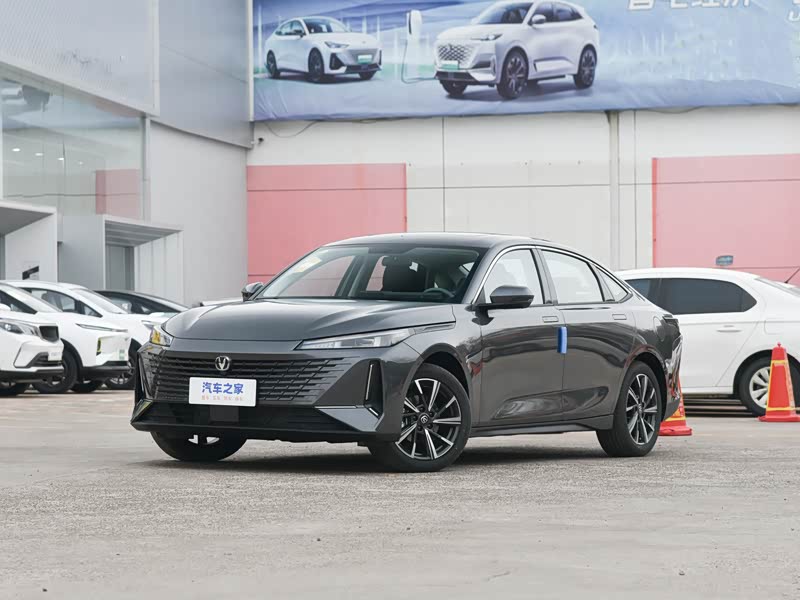
First of all, let’s take a look at Chang ‘an Yida. Its design is more novel, emphasizing the improvement of grade sense. At the same time, its price is relatively close to the people, which is an ideal choice for consumers who pursue cost performance. In terms of performance, Chang ‘an Yida is equipped with 5T turbocharged engine and matched with 7-speed powershift, which is enough to meet daily household needs, and the fuel consumption per 100 kilometers under WLTC is only 99L, which is quite outstanding.

However, Yidong PLUS is more prominent in space and practicality. As a home choice, it shows a more mature positioning. Although Yida may be a little radical in design, its intelligent concept, such as Changan Automobile’s latest smart collar era design in the world, pays attention to fashion and simplicity, creating a unique visual enjoyment. The front face adopts a brand-new family-style design language, and the fog-gray horizontal air intake grille and chrome-plated decorative strips are embellished, which undoubtedly adds to the texture and taste of the whole vehicle.

逸达

Generally speaking, Chang ‘an Yida and Yidong PLUS are the products of Changan Automobile in different market positioning. Consumers should weigh design, performance and price according to their own needs and budgets to make the most suitable choice for them. Whether pursuing novel design or practicality and cost performance, these two models can provide a satisfying experience.

The cruising range of the latest road test spy photos of BMW i5 is expected to exceed 500 kilometers, which will be unveiled in 2023.

Not long after the first spy photos of BMW i5, overseas media took the latest spy photos of this car. Judging from the photos, the new car is still fully armed, but from the "Electric Test Vehicle" logo of the car body, it can be judged that it is a pure electric test vehicle.

This spy shot did not capture the interior part of the vehicle, but the imaginary rendering of this car has been exposed on the Internet. We can see that the BMW i5 has changed a lot on the kidney grille, adopting an integrated style, with a light blue decoration around it, and the two sides of the grille are connected with two headlights respectively, forming a whole running through the front of the car.

The shape of daytime running lights in the light group has also been completely redesigned, which looks much sharper. The triangular diversion grooves on both sides of the front of the car are blackened, and with the air intake grille in the middle, the visual effect is not a mature and steady route, but a sporty and young style.

The shape of the rear of the car is similar to that of the new 7 series. I have to say that the through taillights are really popular with everyone. There are too many layers of design in the whole rear, especially in the position of the rear bumper. As a pure electric vehicle, naturally there is no exhaust device, the position of the exhaust hole is closed and decorated with blue decorative strips.

We haven’t got any reliable news about the power of BMW i5. It is speculated that the cruising range of the car should be more than 500 kilometers, and the battery capacity is more than 80 kWh. It is expected that a single-motor rear-drive version and a dual-motor four-wheel drive version will be available.

As a pure electric version of the new BMW 5 Series, the new car is expected to debut in 2023 at the earliest. Let’s look forward to it.

Surveillance of monkeypox epidemic in September notified by CDC

  CCTV News:According to the website of China CDC, from September 1 to 30, 2023, 305 confirmed cases of monkeypox were newly reported in mainland China (excluding Hong Kong, Macao and Taiwan). Among them, there are 42 cases in Beijing, 40 cases in Guangdong, 38 cases in Zhejiang, 32 cases in Jiangsu, 16 cases in Guangxi, 13 cases in Sichuan, 12 cases in Chongqing, 12 cases in Hubei, 11 cases in Liaoning, 11 cases in Hunan, 9 cases in Shaanxi, 9 cases in Shandong, 8 cases in Hebei, 7 cases in Tianjin, 6 cases in Shanghai, 6 cases in Henan, 6 cases in Fujian, 5 cases in Heilongjiang, 4 cases in Anhui and Jilin.

  According to epidemiological investigation and analysis, the epidemic situation has the following characteristics: First, 99% of the cases are male, 92.9% of the cases are men who have sex with men, and 2 cases are women. Second, other contact methods have low risk of transmission. Only three close contacts except sexual contact were infected. Third, 94.3% were found by active medical treatment, 3.9% were found by follow-up screening of close contacts, and others were found by active reporting and entry screening. Fourth, the clinical manifestations of most cases are typical, mainly for fever, herpes, lymphadenopathy and other symptoms.

Standing at the forefront for forty years, Shenzhen’s meteorology has injected surging power into the construction of smart cities.

   China Meteorological News reporter Ding Jiwu correspondent Tang Li Cai Ran 

  "At 14 o’clock on the 17th, the center of tropical depression is located on the ocean surface about 790 kilometers southeast of Shenzhen, and our station has issued a white warning signal for typhoon …" At 16: 30 on August 17th, Shenzhen Meteorological Observatory released tropical depression information.

  On the 18th, the tropical depression in the South China Sea was strengthened into the No.7 typhoon "Haigaosi" this year. At 11: 00 that day, the Shenzhen Meteorological Early Warning and Forecasting Center issued a typhoon risk warning message to the whole city.

  Heavy rain poured down, including subway line 6 and "north-south artery" line 10 with 15 elevated stations and 12 underground stations. Two subway lines, which can be called "science and technology lines" of the city, were opened to traffic on this day.

  "The operation is stable and has not been affected by the typhoon." Xunsheng Chen, director of Dispatching Room 2 of Shenzhen Metro Dispatching Center, told the reporter. "The weather warning reaches the subway operation command center in seconds, so that we can calmly cope with every weather test."


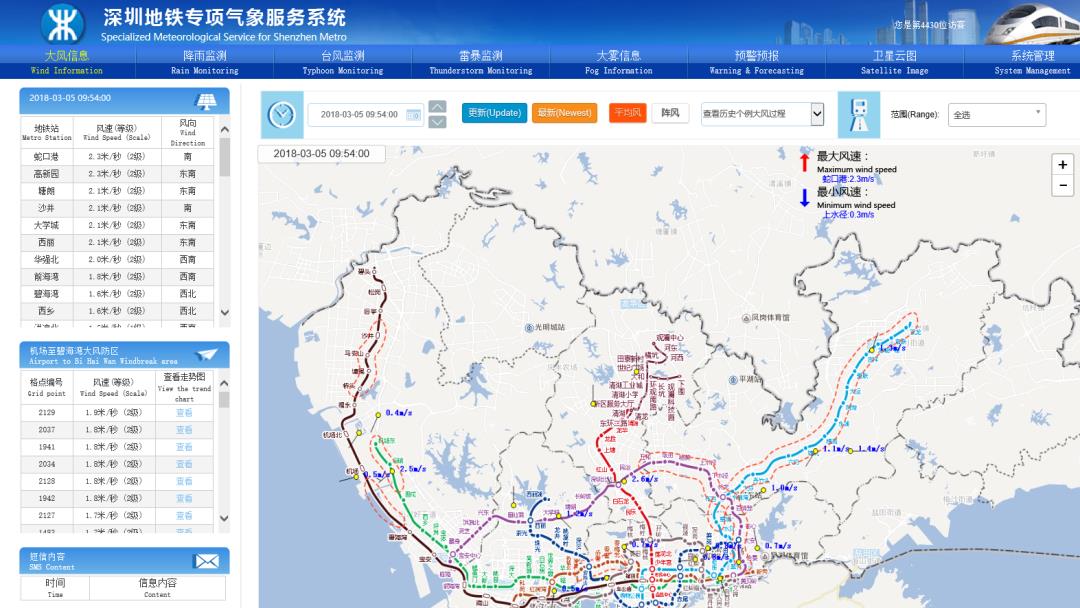
  Special Meteorological Service System of Shenzhen Metro

  As early as 2010, Shenzhen Meteorological Bureau established a real-time online subway intelligent meteorological station with the subway industry as a pilot. After 10 years of operation, Shenzhen has not only built the online subway intelligent meteorological observatory into a benchmark for domestic peers, but also achieved full coverage of meteorological support services in eight lifeline industries, including transportation, water supply, power supply, gas supply and sea area. The coverage rate of urban meteorological safety special services in key units is 100%.

  Smart city, guarded by wisdom. Today, the public safety information distribution chain in Shenzhen has achieved vertical connection with the national and provincial levels, and connected 22 categories and 39 items of information such as natural disasters, public health and accidents in 10 (new) districts and 15 departments of the city, which can complete the information distribution operation of 12 types of channels within 3 minutes with one click.


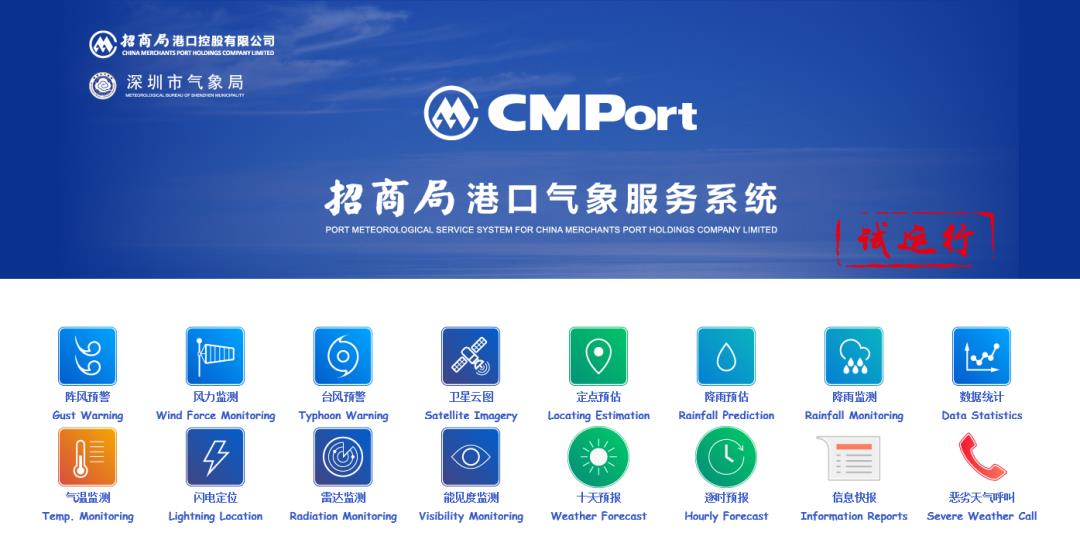
  Shenzhen Port Meteorological Service System

  Integrate into smart cities and make early warning information run faster.

  On the 40th anniversary of the establishment of Shenzhen Special Economic Zone, the construction of Guangdong-Hong Kong-Macao Greater Bay Area and the construction of Socialism with Chinese characteristics Pioneer Demonstration Zone in Shenzhen were rolled out in an all-round way and advanced in depth. Accelerate the in-depth application of digital technology and speed up the running under the digital wave. Shenzhen is sketching out the map of "smart city" with scientific and technological brushstrokes, and the first demonstration is full of enthusiasm.

  The improvement of the intelligent level of urban modernization promotes the integration of meteorology into urban development, and also injects new kinetic energy into meteorological reform and development. In the past 40 years, Shenzhen Meteorological Bureau has implemented the requirements of the municipal party committee and municipal government that "the new era is at the forefront, and the new recruits are brave to be the leading soldiers", and has always adhered to the central task of integrating into the overall large-scale network of China Meteorological Bureau to ensure the economic and social development of the SAR and the safety of the city. With the spirit of reform, innovation, opening up and sharing, Shenzhen has continuously optimized its system and mechanism and explored the meteorological development path with Shenzhen characteristics. In recent years, around the requirements of "two-zone" construction, 74 refined service products in seven categories have been launched, which are fully integrated into the construction of smart cities, and the data of urban lifeline industries and meteorological sensitive industries have been introduced, so that meteorological services can be managed by cities and industries. Go out safely.


    Meteorological data is integrated with the data of urban lifeline industry and meteorological sensitive industry, and the ability of refined meteorological service is improved.

  Around 2012, the population of Shenzhen exceeded 20 million. How to improve the timeliness of meteorological disaster early warning information and expand the information coverage has become a necessary question. It is not easy to answer this question well: as one of the regions with the highest degree of openness and the strongest economic vitality in China, with high-density passenger flow and high-efficiency economic and social activities, the climate effect caused by urbanization is likely to cause frequent extreme weather in Shenzhen, which directly affects the safe development of the city; On the other hand, the urban expansion and population explosion have given birth to new demands for meteorological services in public safety, economic development and environmental protection.

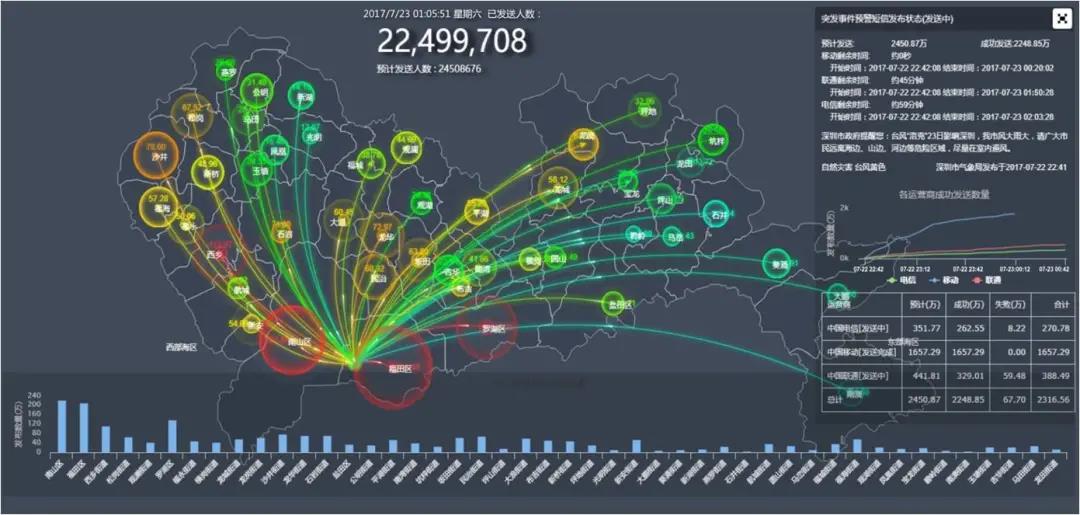
  Develop difficult problems and innovate to make a fuss. Shenzhen Meteorological Bureau reconstructed the early warning short message publishing system based on the concept of "internet plus" and big data, which can cover 22 million users including roaming users within one and a half hours, and the public coverage rate of early warning information has also increased from 80% in 2012 to 100% in 2019.


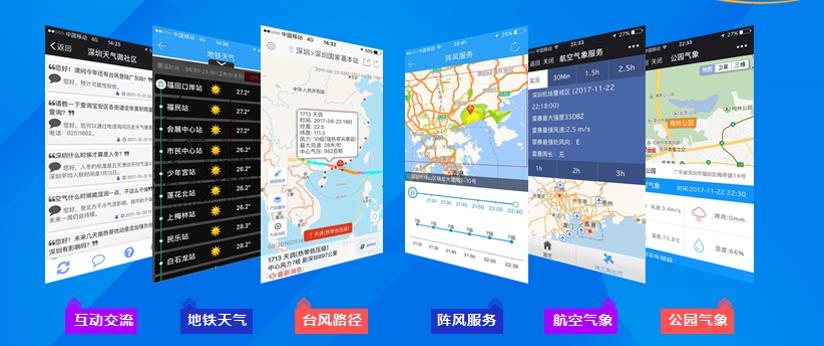
  Shenzhen’s "two micro-ends" intelligent meteorological service


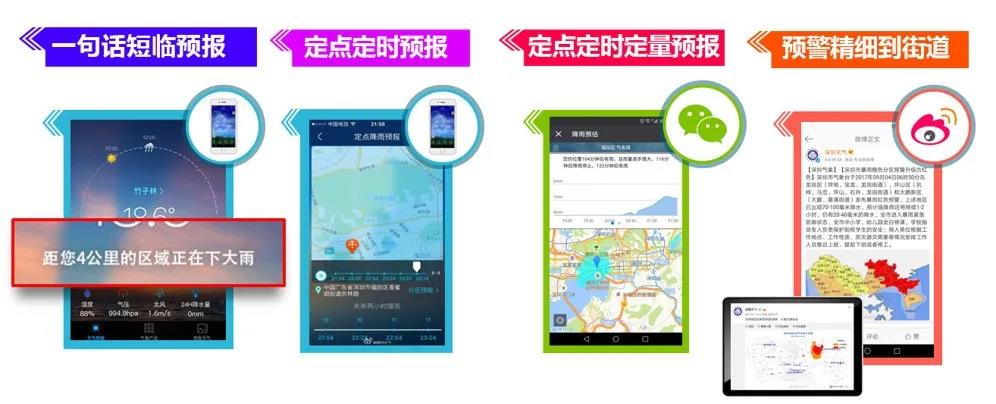
  Shenzhen Meteorological Bureau provides diversified meteorological service products for the public.

  Practice the pioneering spirit and coordinate with the pace of urban development

  From 2012 to 2019, Shenzhen maintained the "double first" in Guangdong Province for eight consecutive years in terms of meteorological modernization evaluation and public meteorological service satisfaction evaluation.

  Let the people living in this land enjoy the best meteorological service, which is the clear goal of the high-quality development of Shenzhen’s meteorological cause-people-centered, ensuring urban disaster prevention and mitigation, management and governance, and meeting the needs of citizens for personalized meteorological services. Adhering to this initial intention, in the past 40 years, meteorological workers in Shenzhen have demonstrated their pioneering spirit to the fullest.

  History will never forget the changes caused by two heavy rains in 1993.

  From June 16 to 17, 1993, the continuous heavy rain caused waterlogging in many places in Shenzhen, and the city stopped for a time; On the evening of September 25th, the rainstorm didn’t stop all night, with 130,000 people affected by the disaster and a direct economic loss of 764 million yuan.

  Two consecutive rainstorms in a year have had a great impact on Shenzhen. At that time, there were no cities in China that issued meteorological disaster warning signals, except for some coastal ports that hung coastal typhoon signals to defend against typhoons and strong winds at sea (mainly used by shipping and fishermen).

  Make compensation for disasters with greater progress. In the second year, Shenzhen took the lead in launching the meteorological disaster early warning signal in China, and the first meteorological disaster early warning signal system in China was born. In 2005, the Emergency Plan for Meteorological Disasters in Shenzhen was issued, and it began to be integrated into the social governance system in 2010. The "Shenzhen Model" of meteorological disaster prevention and mitigation with four levels of linkage of city, district, street and community gradually took shape.


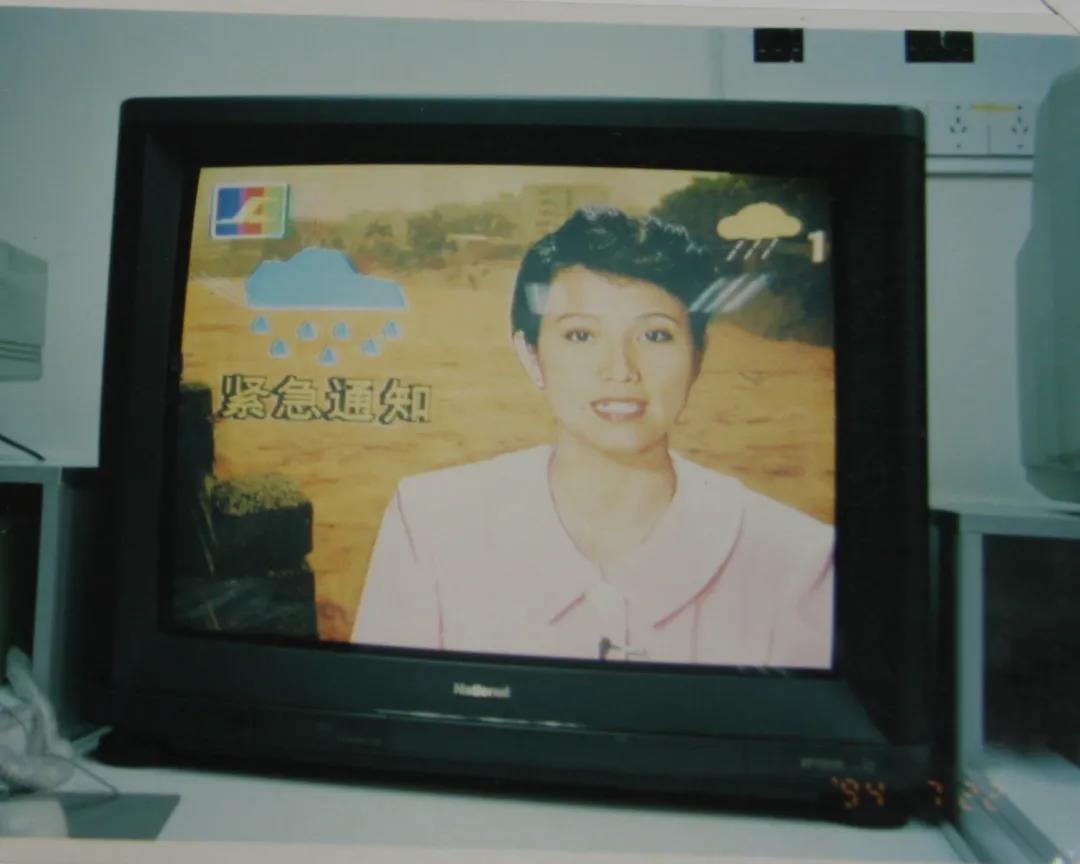
  In 1994, Shenzhen first issued a rainstorm warning signal.

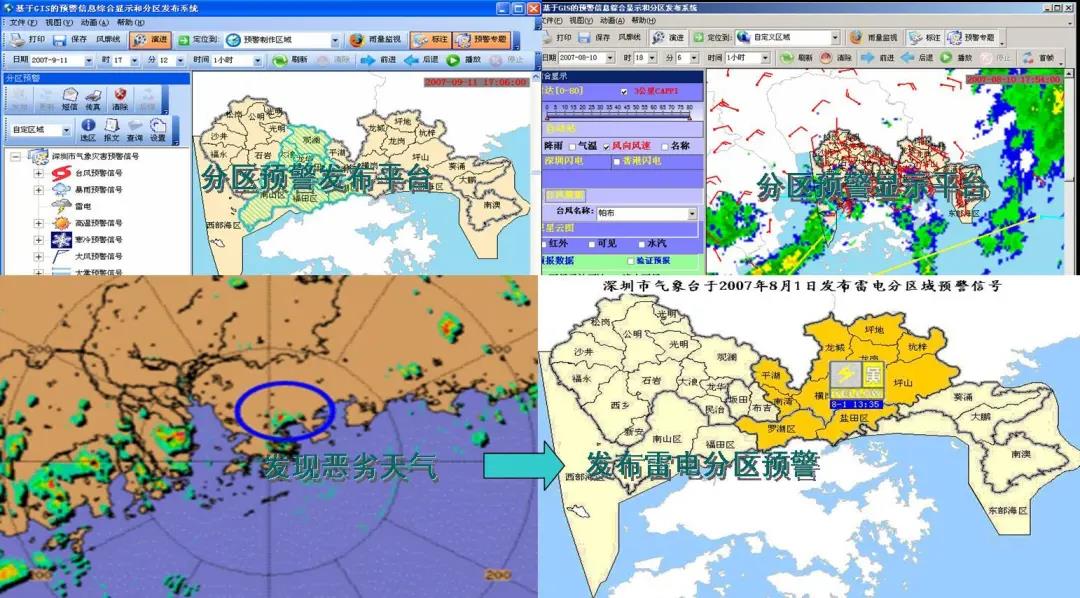
  On July 18, 2007, Shenzhen launched the early warning of meteorological disasters, which is a brand-new attempt at home and abroad. Shenzhen is long and narrow from east to west, and the weather in different regions is very different. The practice of "unified forecasting, early warning in different regions, key tips and point-to-point broadcasting" has effectively improved the accuracy and coverage of early warning and forecasting, and has been included in the national meteorological modernization index reference project.


  Zoning early warning system of meteorological disasters independently developed by Shenzhen Meteorological Bureau

  In 2010, taking the opportunity of the guarantee of meteorological services for the Universiade, Shenzhen launched the 0-to 3-hour rainfall and temperature forecast in all streets of the city, and launched the first pilot project of standardization of meteorological services in China. This innovative attempt once again radiated the power of generate, and was named by China Meteorological Bureau as "Shenzhen Model of Fine Forecast Service for Big Cities", which was popularized throughout the country.

  In 2019, the short-term extreme rainfall of "4.11" exposed the meteorological vulnerability of short-term defense boards and high-density cities. Drawing lessons from a bitter experience, the Municipal Meteorological Bureau and the Municipal Emergency Management Bureau jointly issued the Risk Warning of Major Meteorological Disasters in Shenzhen, which was updated year by year, marking the change from meteorological warning to risk warning. The Regulations on Issuing Meteorological Disaster Warning Signals in Shenzhen, which is planned to be revised in 2020, will further consolidate the linkage mechanism of grass-roots defense and the "four stops" mechanism of high-level early warning.


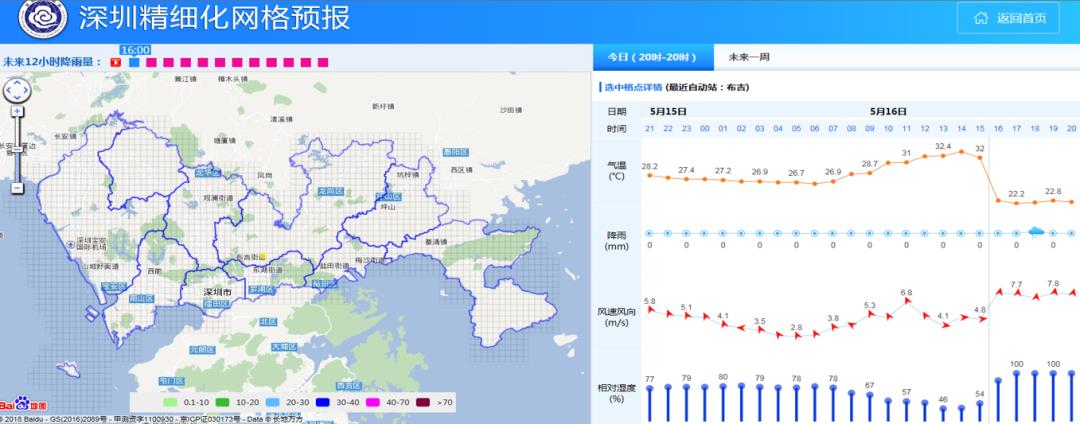
  Shenzhen Fine Grid Forecasting System

  Relying on the advantages of the industry, constructing the ecological chain of meteorological science and technology innovation

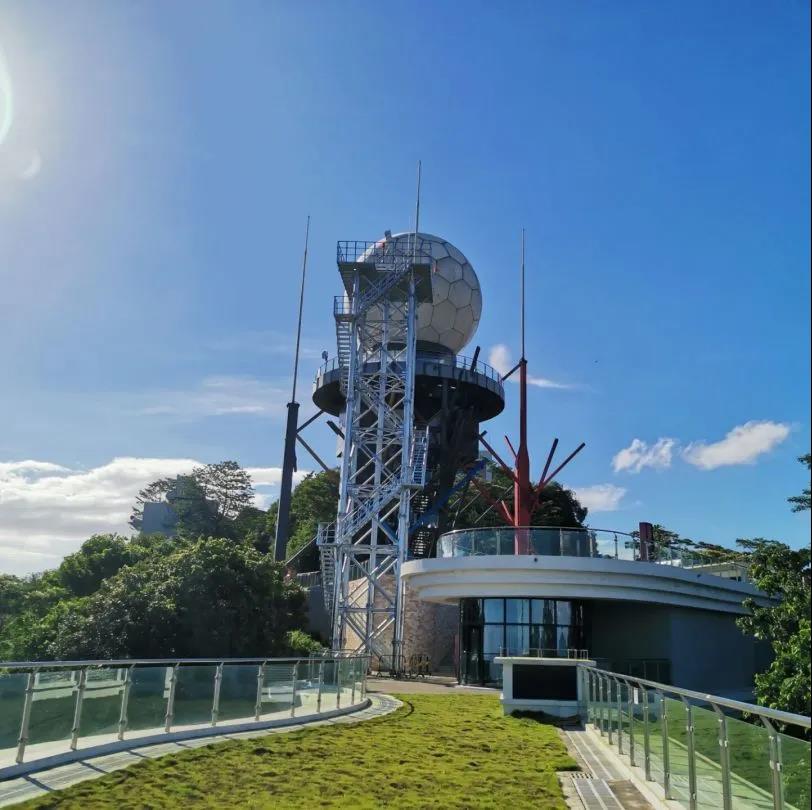
  Dual-polarization weather radar, 365m meteorological gradient tower observation, urban canopy stereo observation, urban unit microclimate observation, space weather observation … Special monitoring strengthens foundation piles to improve the ability of urban precise meteorological disaster prevention and mitigation.


  New generation dual polarization radar


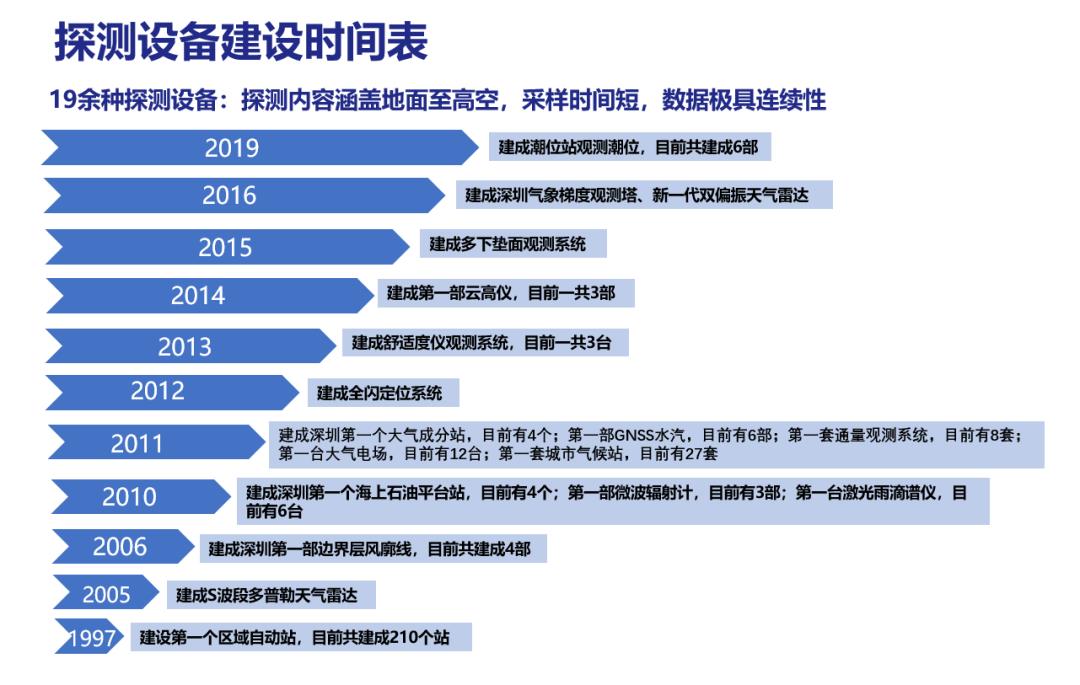
  Construction schedule of meteorological detection equipment in Shenzhen

  Shenzhen has actively integrated into the overall layout of the national meteorological industry and formed a "4+N" meteorological science and technology innovation model: Guangdong-Hong Kong-Macao Greater Bay Area Meteorological Monitoring and Early Warning Center, National Climate Observatory, Shenzhen Southern Key Laboratory of Strong Weather Research, CNAS Lightning Laboratory, and four scientific and technological engines support the high-quality development of meteorological undertakings in Shenzhen in the future; Establish strategic cooperative relations with "n" national business units and local high-tech enterprises, and draw wisdom and leverage to jointly integrate the latest scientific and technological achievements into meteorological applications.


  On November 30th, 2009, Xiyong Observatory, one of the top ten livelihood projects in the 30th anniversary of the establishment of Shenzhen Special Economic Zone, was completed and put into use.


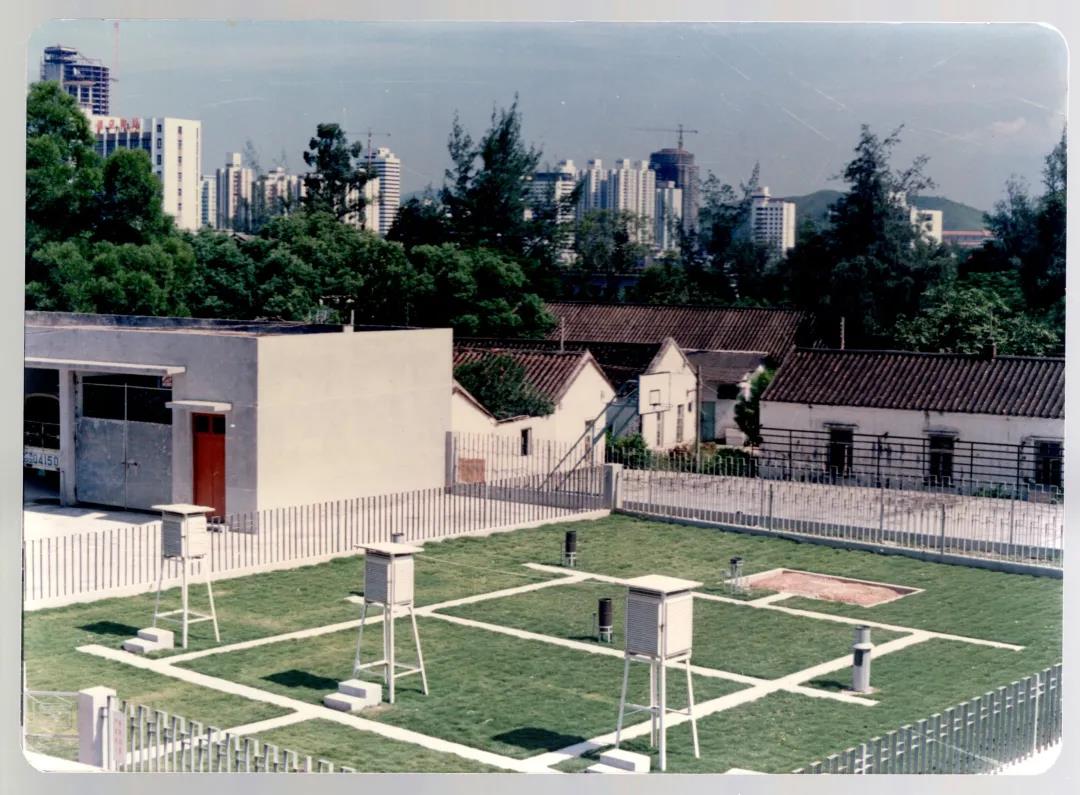
  In June 1987, a corner of the observation field and garage of Shenzhen Meteorological Observatory.

  From the three louver boxes at the beginning of the station to the modern meteorological monitoring system with more and more "magic weapons", a network fully senses the weather changes; From early rough recording and manual collection to real-time sharing of weather and climate integrated intelligent platform with data as the main line, including automatic weather tracking, grading tips, human-computer interaction, rapid production and climate prediction and evaluation, intelligent meteorology is deeply integrated into the city; From "shouting wheat" in the streets, to one-click release of emergency warning information covering 12 categories and 33 distribution channels of traditional media and new media, the public coverage of early warning information has increased to 100%. Over the years, Shenzhen meteorological industry has adhered to quality leadership and innovation drive, and made great achievements in meteorological modernization.


  Shenzhen Emergency Warning Information Release System   

  In order to let the people enjoy better service, it is necessary to further refine the forecast level. In order to solve the key technical problems of forecasting, Guangdong-Hong Kong-Macao Greater Bay Area Meteorological Monitoring, Early Warning and Forecasting Center was established in due course. Shenzhen can be said to be the place with the densest radar and the densest automatic stations in China. However, the more data, the more difficult it is to process after entering the mode. "In the huge system of numerical forecasting, data assimilation is the most difficult bone. The goal of Guangdong-Hong Kong-Macao Greater Bay Area Meteorological Monitoring and Early Warning Center is very clear, that is, to come up with the best data assimilation system in numerical forecasting." Mao Xia, deputy director of Shenzhen Meteorological Bureau, said.

  The Outline of Guangdong-Hong Kong-Macao Greater Bay Area Development Plan puts forward that we should make full use of modern information technology to realize the intelligent management of urban agglomerations; It is necessary to build an efficient and scientific meteorological disaster prevention and control system, improve the ability of the whole society to prevent and control natural disasters, and ensure the construction of smart urban agglomerations in Greater Bay Area. The construction of Guangdong-Hong Kong-Macao Greater Bay Area Meteorological Data Center will provide better meteorological support services for the joint defense of meteorological disasters, road traffic, sea routes and air travel of Greater Bay Area world-class urban agglomerations.

  "We have been climbing the hill." Wang Yanqing, director of the Shenzhen Meteorological Bureau, said that the fundamental purpose of smart weather service smart city construction is not to make the city "tall", but to make technology truly serve the general public, serve the high-quality development of the city, make urban governance more refined, and make people’s lives better.

  (Source: Shenzhen Meteorological Bureau Editor: Zhang Linyi)

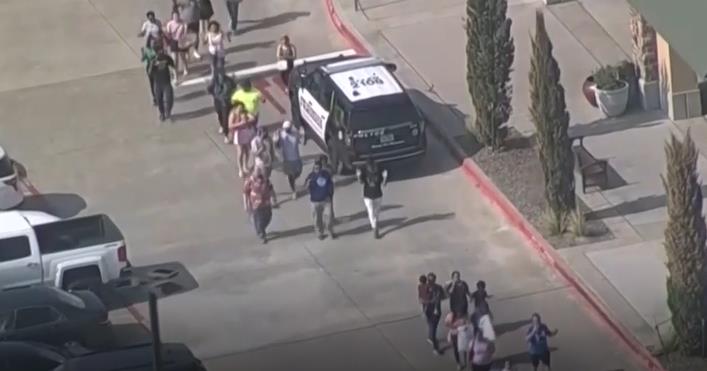
Shooting at a shopping mall in Texas, USA: The gunman fired more than 40 shots at the crowd.

Wechat picture _20230507110233.png

People left the scene after the shooting (AP video screenshot)

  Overseas Network May 7 th According to CBS, on the afternoon of May 6, local time, a shooting incident occurred in a shopping mall in Texas, USA, killing at least 9 people and injuring 7 others, 3 of whom were seriously injured. The gunman has been killed.

  Jonathan Boyd, the fire chief of Allen, Texas, said that seven people, including the gunman, died on the spot. Nine people were taken to hospital after being shot, and two of them died. Three of the injured are undergoing serious injury surgery. Ryan Harvey, chief of the Allen Police Department, said that a policeman rushed to the scene after hearing the gunshots and killed the gunman. The gunman committed the crime alone.

  The live video shows that the gunman parked his car outside the shopping center and started shooting more than 40 shots at the crowd after getting off the bus. Gum, a staff member of the mall, said that about 300 people fled at the scene and people were frightened. "I heard screams." A customer said that he saw the gunman holding an assault rifle and shooting at people. "We saw people fall down after being shot." (Overseas Network/Li Fang)

Rare for the first time! Interfere with the US election? Russian citizens and entities were prosecuted.

       CCTV News:Early this morning, Beijing time, the US Department of Justice announced that Miller, the special prosecutor in charge of the investigation of "TongRumen", had formally filed a lawsuit against 13 Russian citizens and three Russian entities on the grounds that they were suspected of interfering in the 2016 US presidential election.

       In Miller’s indictment, it was written that in the 2016 US presidential election, these 13 Russian citizens and three Russian entities spread political advertisements on social media under the guise of some American citizens and American companies to support the then presidential candidate Trump and slander another candidate Hillary Clinton, which constituted an "information war" against the United States. It is reported that all the defendants involved will be charged with "conspiracy to defraud the United States", in addition, three of them are also charged with "wire transfer fraud" and "bank fraud", and the other five defendants are charged with "serious identity theft".

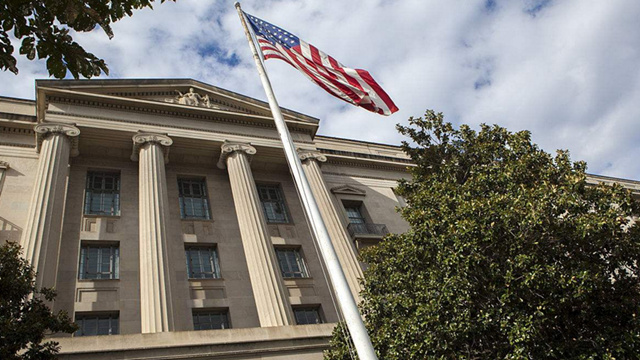
the U.S. Department of Justice

the U.S. Department of Justice

       Pelosi, leader of the Democratic Party of the US House of Representatives, said on the same day that the latest results of the "TongRumen" survey showed that Russia’s intervention in the 2016 US presidential election was "irrefutable evidence". US President Trump responded on social media that Russia’s intervention in American politics began in 2014, but he stressed that his campaign team has nothing to do with Russia.

       This is the first time that the Russian people have been charged since the launch of the "investigation on Russia". Rosenstand, Vice Minister of Justice, also stressed that no Americans have been found to have knowingly assisted the Russians in intervening in the 2016 US presidential election.

       Trump: No collusion with Russia

       Regarding this latest accusation of "TongRu" investigation, in the early morning of Beijing time, US President Trump also issued a statement through the White House, stressing that special prosecutor Miller’s investigation showed that there was "no collusion" between his campaign team and Russia, and the result of the 2016 US presidential election was not affected by any external forces.

one

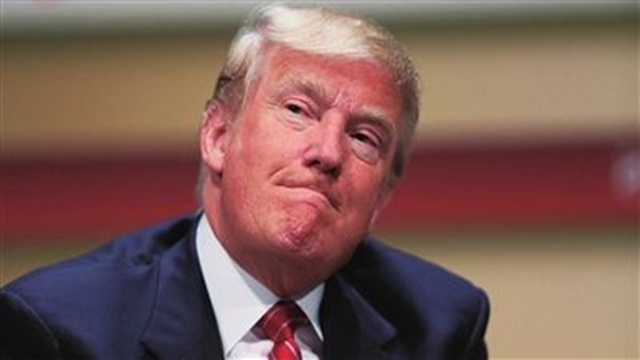
US President Trump

       Trump said that it is time to stop those strange partisan disputes. Such irrelevant subjective accusations as his campaign team’s "communication with Russia" will only make "some bad guys" — — Russia, for example, profited from it.

       Russia refutes the findings of the US Department of Justice.

       After the US Department of Justice announced the latest investigation results of "TongRumen", the Russian side refuted it for the first time.

one

Russian Foreign Minister Lavrov

       Russian Foreign Minister Lavrov stressed that Russia "cannot and will not" interfere in the US election, and the findings of the US Department of Justice lack evidence. Russian Foreign Ministry spokesman Zacharova said in a statement that the US accusation is ridiculous.

Nanjing’s land compensation policy for new energy vehicles was released, and passenger cars were subsidized 1: 0.5 times according to the state compensation.

Source: First Electric Network

On June 23rd, the Nanjing Municipal Government issued the Financial Implementation Rules for the Promotion and Application of New Energy Vehicles in Nanjing in 2017. According to the plan, in the promotion and application plan of new energy vehicles in Nanjing in 2017, the total number of new energy vehicles in Nanjing is 2,500, and the total number of new energy vehicle charging facilities construction plans is 3,000, including 1,770 AC piles and 1,230 DC piles.
In terms of subsidy standards, except for special vehicles for new energy, they are all subsidized by the state at 1:0.5 times, and the total amount of provincial subsidies and urban subsidies does not exceed 60% of the car price after deducting state subsidies.

Subsidy for the construction of new charging facilities: financial funds will subsidize the construction and operation units of charging facilities in public areas according to the charging power of charging piles, with 600 yuan per kilowatt for AC charging piles and 900 yuan per kilowatt for DC charging piles. The total subsidy for a single charging station or charging pile group shall not exceed 1.8 million yuan.

Subsidy for the operation of new charging facilities: According to the statistics of the municipal charging facilities supervision platform, if the average monthly charging time of a single pile reaches 20 hours in 2017, the newly-built charging facilities that have passed the acceptance in 2017 will be subsidized according to 200 yuan per kilowatt of AC charging piles and 300 yuan per kilowatt of DC charging piles.

The original text of the announcement is as follows:

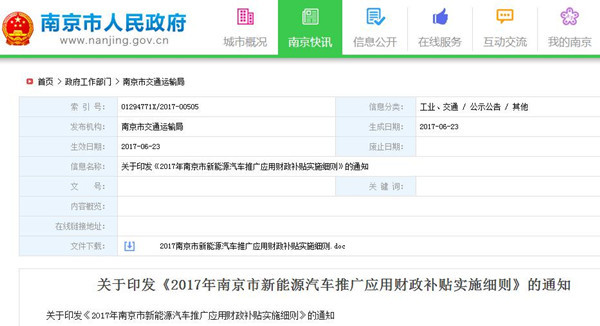
Notice on Printing and Distributing the Detailed Rules for the Implementation of Financial Subsidies for the Promotion and Application of New Energy Vehicles in Nanjing in 2017

The District (Development Zone) Finance Bureau, the lead unit for the promotion and application of new energy vehicles, and the relevant departments of the city:

According to the spirit of the Provincial Department of Finance and the Provincial Economic Information Commission’s Notice on Doing a Good Job in Local Financial Subsidies for the Promotion and Application of New Energy Vehicles in 2017 (Su Cai Gong Mao [2017] No.13), and with the consent of the municipal government, the Detailed Rules for the Implementation of Financial Subsidies for the Promotion and Application of New Energy Vehicles in Nanjing in 2017 are hereby printed and distributed to you, please follow them.

Nanjing Finance Bureau Nanjing New Energy Automobile Promotion

Office of the leading group for application work

June 22, 2017

Attachment:

Detailed rules for the implementation of financial subsidies for the promotion and application of new energy vehicles in Nanjing in 2017?

?????According to the spirit of the Notice on Adjusting the Financial Subsidy Policy for the Promotion and Application of New Energy Vehicles (Cai Jian [2016] No.958) issued by the Ministry of Finance, the Ministry of Science and Technology, the Ministry of Industry and Information Technology and the Development and Reform Commission, and the Notice on Doing a Good Job in the Local Financial Subsidy for the Promotion and Application of New Energy Vehicles in 2017 (Su Cai Industry and Trade [2017] No.13) issued by the Provincial Department of Finance and the Provincial Economic and Information Commission, combined with the new energy in our city,

First, the financial subsidy object

The financial subsidy targets are the buyers of new energy vehicles and the construction and operation units of charging facilities in the public service field in this city.

(1) Subsidized models and requirements of new energy vehicles

New energy vehicles refer to automobiles (inclusive) and automobiles that are included in the National Catalogue of Recommended Vehicles for the Promotion and Application of New Energy Vehicles. Among them: private consumers are limited to buying new energy passenger cars.

The types of subsidized vehicles are as follows:

1. Bus

(1) Buses: buses purchased by public transport enterprises with the consent of the urban people’s government, including city buses, town buses and vehicles engaged in public transport operations through leasing;

(2) Other buses: including road passenger vehicles and enterprise-owned vehicles. Road passenger vehicles refer to buses that transport passengers, provide services to the public and have commercial road passenger activities, including shuttle buses (overtime buses), chartered buses and tourist buses; Enterprise-owned vehicles refer to vehicles purchased by enterprises for commuting and business reception of employees.

2. Special purpose vehicle

(1) Postal and logistics vehicles: refer to vehicles that have obtained the qualification of road freight transportation and provide goods transportation;

(2) Municipal, sanitation, engineering vehicles, etc.: vehicles that provide urban roads with cleaning, sanitation, industrial protection, patrol and other purposes.

3. Passenger cars

(1) Taxi: a vehicle with taxi operation qualification and providing city taxi service;

(2) Private and enterprise vehicles: vehicles purchased by private consumers or enterprises for their own use;

(3) Official vehicles: official vehicles of administrative institutions;

(4) Rental vehicles: vehicles that are applied in the mode of vehicle rental or vehicle sharing.

The purchase of new energy vehicles by wholly state-owned or state-controlled enterprises at the provincial level shall be implemented in accordance with relevant provincial regulations. If financial funds are used to purchase new energy vehicles, provincial and municipal finance will no longer give car purchase subsidies.

(2) Requirements for subsidies for the construction of charging facilities in the field of public services

The construction and operation units of charging facilities in public areas meet the requirements of Jiangsu Province’s measures for the construction, operation and management of charging facilities for new energy vehicles in public areas, Jiangsu Province’s detailed rules for the acceptance of charging facilities for new energy vehicles in public areas and Nanjing’s relevant management measures. The construction of charging facilities meets the relevant planning standards of provinces and cities.

New energy vehicles and charging facilities that are included in financial subsidies must meet the technical requirements stipulated by relevant departments at all levels.

?Second, the financial subsidy policy

(a) vehicle purchase financial subsidy standards:

See Annex 1 for the purchase subsidy standards of various new energy vehicles. The total financial subsidy shall not exceed 60% of the selling price of the car after deducting the state subsidy (subject to the sales invoice).

(two) the standard of financial subsidy for the construction (operation) of charging facilities:

The financial subsidy for the construction of charging facilities consists of subsidies for the construction of new charging facilities and subsidies for the operation of new charging facilities.

1. Subsidies for the construction of new charging facilities:

The financial funds will subsidize the construction and operation units of charging facilities in public areas according to the charging power of charging piles, with 600 yuan per kilowatt for AC charging piles and 900 yuan per kilowatt for DC charging piles. The total subsidy for a single charging station or charging pile group shall not exceed 1.8 million yuan.

2. Operating subsidy for new charging facilities:

According to the statistics of the municipal charging facilities supervision platform, if the average monthly charging time of a single pile reaches 20 hours in 2017, the newly-built charging facilities that have passed the acceptance in 2017 will be subsidized according to 200 yuan per kilowatt of AC charging piles and 300 yuan per kilowatt of DC charging piles.

(3) Relevant subsidy policies

1. According to the promotion and application plan of new energy vehicles in Nanjing in 2017, the total number of new energy vehicles promoted in the city is 2,500, and the subsidized vehicles are planned to enjoy financial subsidies according to the vehicle registration time.

2. In 2017, the total planned construction of new energy vehicle charging facilities in our city is 3,000, including 1,770 AC piles and 1,230 DC piles, and the finance will give subsidies according to the total amount and types of charging piles.

Three, the financial subsidy funds declaration and disbursement process

(1) The financial allocation shall be declared at different levels: all enterprises, institutions and mass organizations that purchase and use new energy vehicles shall apply for financial subsidy funds according to the principle of territorial registration in industrial and commercial registration. Private passenger cars apply for financial subsidy funds according to the principle of the location of the consumer’s household registration or residence permit. Charging facilities shall apply for financial subsidy funds according to the principle of construction location.

1. Consumers in the field of public service of new energy vehicles shall apply according to the lead unit for the promotion and application of new energy vehicles in the local area. Private consumers of new energy vehicles shall apply to the lead unit for the promotion and application of new energy vehicles in the district by the automobile sales organization (4S shop). The subsidy funds for charging facilities shall be applied to the lead unit for the promotion and application of new energy vehicles in the district where the charging facilities are located by the contractor service operation unit. Consumers of provincial state-owned enterprises or state-holding enterprises and municipal public transport enterprises directly apply to the Office of the Leading Group for the Promotion of New Energy Vehicles.

The lead unit for the promotion and application of new energy vehicles in the district, and the district financial audit summary shall be reported to the office of the leading group for the promotion and application of new energy vehicles in the city and the Municipal Finance Bureau.

2. If a private consumer purchases a new energy vehicle, the automobile sales organization (4S shop) shall settle the account with the private consumer at the price after deducting the subsidy. If the automobile sales organization (4S shop) fails to implement this regulation, it will be disqualified from applying for financial subsidies for new energy vehicles in the next year after verification. The processing result shall be copied to the vehicle manufacturer and announced to the public.

(II) Procedures for financial subsidy declaration: All declarations are made online. The specific steps are as follows:

1. The applicant shall register an account with the website of the new energy vehicle information management platform (website address: http://221.226.86.226:9012/nyqc/);

2. After the registered account has been approved by the leading department for the promotion and application of new energy vehicles in the district, the reporting unit can log on to the website for daily reporting (the daily reporting is not limited by the reporting date);

3. The platform will open the declaration channels from July 1 to 15 (the first batch), September 1 to 15 (the second batch), November 1 to 15 (the third batch) and January 1 to 15 (the fourth batch) of the following year. Enterprises must declare within the declaration date, and the overdue declaration channels will be automatically closed. A declaration period can be declared once. If the application materials do not meet the requirements, they can be returned for correction. If they still fail to meet the requirements at maturity, this batch will not be declared, but can be declared in the next batch. The fourth batch of applications that fail to pass and fail to report within the time limit will no longer be accepted.

4. The applicant shall provide three copies of paper application materials (with watermark) printed from the platform to the District New Automobile Office within 10 working days after the examination and approval at the district and municipal levels, and affix the official seal (signature).

The Finance Bureau of each district and the lead department for the promotion and application of new energy vehicles shall, within 15 working days after each declaration, submit to the Municipal Finance Bureau and the Office of the Leading Group for the Promotion and Application of New Energy Vehicles a report on the application for disbursement of funds in this region, a summary of the application for financial subsidies for the promotion and application of new energy vehicles (vehicle purchase) (Table 2-1), a summary of the application for financial subsidies for the promotion and application of new energy vehicles (Construction of charging facilities) (Table 2-2) and related application materials, as well as an arrangement plan for financial subsidies in this region.

(three) the allocation of financial subsidies

The financial subsidies for consumers of new energy vehicles are allocated by the district finance.

The financial subsidy funds for charging facilities shall be allocated by the local financial department to the construction service operation unit.

The financial subsidies of provincial wholly state-owned or state-controlled enterprises and municipal public transport enterprises shall be allocated by the municipal finance to the group company or the competent department of the enterprise.

Subsidy funds are planned to be issued at the end of August, the end of October, before the end of December and after the liquidation with the province in the following year. According to the batch and order of subsidy declaration, the municipal finance will allocate provincial and municipal subsidy funds to all districts. Each district will distribute the subsidy funds (including the supporting parts of the district) in place within 15 working days after receiving the funds.

Four, the financial subsidy application materials

1, consumers in the public sector to apply for financial subsidies for the purchase of new energy vehicles, the need to submit a summary of the application of financial subsidies for the promotion and application of new energy vehicles (vehicle purchase) (Table 2-1) and the following materials:

(1) Application form for financial subsidy funds for the promotion and application of new energy vehicles (vehicle purchase) (Annex 3-1);

(2) A copy of the business license, organization code and tax registration certificate of the enterprise;

(3) Copies of vehicle purchase and sale contracts, purchase and sale invoices and other vouchers;

(4) A copy of the vehicle registration certificate and driving license issued by the public security department at the place of registration;

(5) Qualification certificates related to vehicle use and vehicle operation;

(6) the authenticity of the submitted materials and the commitment not to transfer the vehicle within 5 years;

(7) Commitment to ensure the normal operation of vehicles;

(8) Vouchers and explanatory materials such as vehicle catalog batch, technical parameters, after-sales service capability and warranty commitment (to be stamped by the manufacturer);

(9) Enterprises engaged in vehicle leasing business shall provide relevant qualification certificates, and ensure the normal and safe driving of new energy vehicles used for leasing.

(10) If a wholly state-owned or state-controlled enterprise purchases a new energy vehicle, it shall be submitted by the provincial first-class group company or the competent department to the relevant municipal departments.

(11) Other materials that need to be explained.

2. When an automobile sales organization (4S shop) applies for financial subsidy funds for the purchase of new energy passenger cars in the private sector, it is required to submit the application summary of financial subsidy funds for the promotion and application of new energy vehicles (vehicle purchase) (Schedule 2-1) and the following materials:

(1) Application form for financial subsidy funds for the promotion and application of new energy vehicles (vehicle purchase) (Annex 3-1);

(2) A copy of the business license, organization code and tax registration certificate of the sales organization (4S shop);

(3) Copies of vehicle purchase and sale contracts, purchase and sale invoices and other vouchers;

(4) A copy of the motor vehicle license plate, registration certificate and driving license issued by the public security department at the place of registration;

(5) Copy of the ID card, residence booklet or residence permit of the car buyer (proof of payment of social insurance fund in Ning for more than one year is required for non-local household registration);

(6) Vouchers and explanatory materials such as vehicle catalog batch, technical parameters, after-sales service capability and warranty commitment (to be stamped by the manufacturer);

(7) the authenticity of the submitted materials and the commitment not to transfer the vehicle within 5 years;

(8) Other materials that need to be provided.

3. The construction and operation unit applying for financial subsidy funds for the construction of charging facilities shall submit the application summary table of financial subsidy funds for the promotion and application of new energy vehicles (construction of charging facilities) (Table 2-2) and the following materials:

(1) application form for financial subsidy funds for the promotion and application of new energy vehicles (construction of charging facilities) (table 3-2)

(2) Business license, organization code and tax registration certificate of the enterprise as a legal person;

(3) A copy of the approval document for project filing;

(4) Project construction and operation plan;

(5) Construction cost budget, purchase contract and invoice of relevant equipment, project construction entrustment contract, etc.;

(6) The project acceptance materials provided by the relevant inspection agencies entrusted by the lead department of the promotion and application of new energy vehicles in the city and district;

(7) Other materials that need to be provided.

4. The above materials shall be scanned and uploaded according to the format specified on the declaration platform, and the original shall be kept for future reference.

?V. Other requirements

(a) to enjoy the financial subsidy funds of new energy vehicle buyers registered in the city, non registered private consumers to buy new energy passenger cars to apply for financial subsidy funds, need to pay social insurance funds at the place of registration for more than one year; In principle, the charging facilities in the public service sector that enjoy financial subsidies shall not be removed. If it is really necessary to remove them due to planning adjustment and other reasons, it shall be reported to the office of the coordination group for the promotion and application of new energy vehicles in the city and district for the record, according to the "Measures for the Construction and Operation Management of New Energy Vehicle Charging Facilities in the Public Sector of Jiangsu Province (Trial)".

(II) All vehicles enjoying financial subsidies shall not be transferred within 5 years. If the purchaser really needs to transfer due to bankruptcy and other special reasons, it shall be reported to the office of the coordination group for the promotion and application of new energy vehicles in the city and district for the record, and it can only be transferred within the scope of registration.

(3) All subsidized vehicles are not allowed to operate outside the scope of Nanjing. If violations are found, the relevant departments have the right to stop the disbursement of subsidies or request the return of subsidized funds. If it is found that the new energy vehicles applying for subsidies are idle or "fraudulently compensated", all subsidies will be stopped. If subsidies have been paid, the reporting unit must return the subsidy funds. If the circumstances are serious, the responsibility will be investigated according to law.

(IV) From January 1, 2017, all newly-produced new energy vehicles will be equipped with on-board terminals. New energy vehicle manufacturers will monitor and manage the operation safety status of key systems such as complete vehicles and power batteries through the enterprise monitoring platform, and upload the vehicle-related safety status information in the public service field (except privately-purchased passenger cars) to the Nanjing monitoring platform according to the requirements of the national standard Technical Specification for Remote Service and Management System of Electric Vehicles (GB/T 32960). For the new energy automobile products that have been sold, the whole vehicle enterprise shall provide the upgrade and transformation services of related monitoring systems such as vehicle terminals and communication protocols free of charge in accordance with the requirements of national standards, promptly notify users to explain the necessity of remote safety monitoring, and incorporate them into the monitoring platform before the end of September 2017.

(V) Charging facilities construction and operation enterprises should establish and improve enterprise monitoring platform, monitor the safety status of charging facilities in real time, and in accordance with the requirements of the Technical Specification for Monitoring System of Intelligent Charging and Switching Service Network Operation of Electric Vehicles (NB/T33017), charging facilities that declare subsidies must upload their relevant data to Nanjing monitoring platform.

(six) new energy vehicle manufacturers should ensure the safety and reliability of products, with the ability to ensure the normal use of new energy vehicles after-sales service. For vehicles applying for financial subsidy funds for new energy vehicles in our city, vehicle production enterprises shall have more than one vehicle service station in our city, and be responsible for providing quality assurance to consumers and recycling and disposing of waste batteries in accordance with the requirements of the national Catalogue of Recommended Vehicles for Promotion and Application of New Energy Vehicles. Enterprises or units that purchase new energy buses or special vehicles should have the ability to use the relevant vehicles normally and use them properly and reasonably, and ensure the safe operation of the vehicles; Operating vehicles shall comply with the relevant provisions of the Regulations of Jiangsu Province on Road Transportation. The construction and operation units of charging facilities in the public service field shall ensure the normal and safe use of charging facilities.

Six, apply for financial subsidies for new energy vehicle buyers, sales agencies, public service charging facilities construction and operation units responsible for the authenticity of the application materials submitted; Those who cheat financial subsidy funds by providing false information, failing to guarantee the normal operation of new energy vehicles, and failing to meet the requirements of vehicle technical parameters will recover the subsidy funds, cancel the subsidy qualification, and be punished in accordance with the Budget Law of the People’s Republic of China, the Regulations on Penalties and Punishment for Financial Violations, and the Measures for Financial Supervision of Jiangsu Province.

Seven, the detailed rules for the implementation by the Municipal Finance Bureau, the office of the leading group for the promotion and application of new energy vehicles is responsible for the interpretation, during the implementation period, such as the introduction of new policies by the state and province, according to the new policy. These Measures shall be valid until December 31, 2017.

Attachment:

1. Financial subsidy standards and product technical requirements for the promotion and application of new energy vehicles in 2017.

2-1 Summary of Financial Subsidies for the Promotion and Application of New Energy Vehicles (Vehicle Purchase)

2-2 Summary of Financial Subsidies for the Promotion and Application of New Energy Vehicles (Construction of Charging Facilities)

3-1. Application Form for Financial Subsidies for the Promotion and Application of New Energy Vehicles (Vehicle Purchase)

3-2. Application Form for Financial Subsidies for the Promotion and Application of New Energy Vehicles (Construction of Charging Facilities)

4, unit load mass energy consumption evaluation index

5. Contact Table for Promotion and Application of New Energy Vehicles in Various Districts

Financial subsidy standards and products for the promotion and application of new energy vehicles in 2017technical requirement

I subsidy standards and technical requirements for new energy buses

(A) new energy bus subsidy standards

1. Subsidy amount for new energy buses = vehicle power consumption x subsidy standard for unit power consumption x adjustment coefficient (adjustment coefficient: system energy density/charging rate/fuel saving level), as follows:
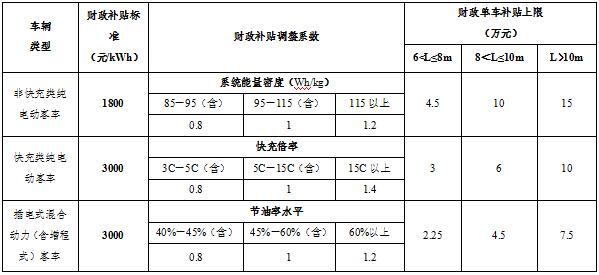
  • Subsidy standards for other new energy buses
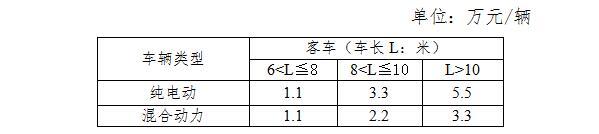
(2) Technical requirements for new energy buses

1. Energy consumption per unit load (Ekg) is not higher than 0.24 Wh/km kg.

2. The continuous driving mileage of buses (excluding fast-charging and plug-in hybrid buses) shall not be less than 200 kilometers (constant speed method).

3. The proportion (m/m) of the total mass of the battery system to the whole vehicle kerb mass is not higher than 20%.

4. The energy density of battery system of non-fast charging pure electric bus is higher than 85Wh/kg, the fast charging rate of fast charging pure electric bus is higher than 3C, and the fuel saving rate of plug-in hybrid bus (including extended range) is higher than 40%.

Two, new energy passenger car subsidy standards and technical requirements

(1) The subsidy standards for the promotion and application of new energy passenger cars and plug-in hybrid (including extended range) passenger cars are as follows:
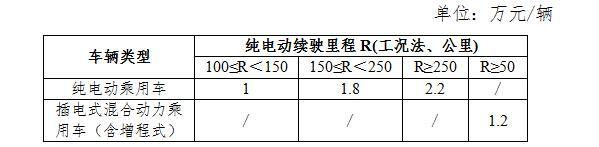

(II) Technical Requirements for New Energy Passenger Cars

  1. The maximum speed of a pure electric passenger car for 30 minutes is not less than 100 km/h.
  2. The mass energy density of the power battery system of the pure electric passenger car is not less than 90Wh/kg, and the subsidy is 1.1 times higher than 120Wh/kg.
  3. For pure electric passenger car products, according to the different kerb mass (m) of the whole vehicle, the power consumption (y) per 100 kilometers under working conditions should meet the following requirements: when m≤1000kg, y ≤ 0.014× m+0.5; When 1000<m≤1600kg, y ≤ 0.012× m+2.5; When m>1600kg, Y≤0.005×m+13.7.
  4. The fuel consumption of plug-in hybrid passenger car in state B (fuel consumption excluding electric energy conversion) with pure electric driving range less than 80km is less than 70% compared with the corresponding limit in the current national standard for conventional fuel consumption. The plug-in hybrid passenger car with pure electric driving range greater than or equal to 80km, its A-state 100 km power consumption meets the same requirements as pure electric passenger cars.

Three, pure electric trucks and special vehicles subsidy standards and technical requirements

(1) Pure electric trucks and special purpose vehicles shall be subsidized by the way of over-regressing in sections, based on the total storage capacity of power batteries providing driving power, as follows:


(2) Technical requirements for new energy trucks and special vehicles

  1. The mass energy density of the power battery system is not less than 90Wh/kg.
  2. The energy consumption per unit load (Ekg) of pure electric trucks and transport special vehicles is not higher than 0.5 Wh/km kg, and the power consumption per ton of other pure electric special vehicles (according to the test quality) is not more than 13kWh.

Four, fuel cell vehicle subsidy standards and technical requirements

(1) The subsidy standards for the promotion and application of fuel cell vehicles are as follows:
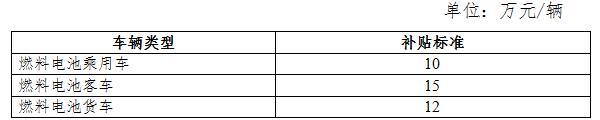
(2) Technical requirements for fuel cell vehicles

  1. The rated power of the fuel cell system is not less than 30% of the rated power of the driving motor and not less than 30kW. Fuel cell passenger cars with rated power of fuel cell system greater than 10kW but less than 30kW will be subsidized according to the rated power of fuel cell system of 3,000 yuan /kW.

2. The driving range of fuel cell vehicles with pure electricity shall not be less than 300 kilometers.

V. Technical Requirements for Power Battery

The power battery used in new energy vehicles shall meet the following standards:

  1. Energy storage devices (monomer, module): zinc-air battery for electric road vehicles (standard number GB/T 18333.2-2015, article 6.2.4/article 6.3.4 will not be implemented for the time being), vehicle supercapacitor (standard number QC/T 741-2014), cycle life requirements and test methods of power battery for electric vehicles (standard number QC/T 741-2014) 6.5 Cycle life under working conditions will not be implemented for the time being), safety requirements and test methods of power storage batteries for electric vehicles (standard numbers GB/T 31485-2015, 6.2.8 and 6.3.8 are not implemented for the time being).
  2. Energy storage devices (battery packs): lithium-ion power battery packs and systems for electric vehicles Part 3: Safety requirements and test methods (standard number GB/T 31467.3-2015).