[In-depth Interview] Interview with Professor Chu Xiaobo —— China’s Japanese Studies: History, Present Situation and Prospect
Small I reading guide
China has been studying Japanese for thousands of years. In this long history, what stages, characteristics and influencing factors did China’s Japanese studies go through?
Chu Xiaobo, Party Secretary and Professor of Peking University Institute of International Relations, and academic member of Peking University Sino-foreign Humanities Exchange Research Base, was interviewed by Li Yaoxing, a special correspondent of International Politics Research and a doctoral student of Peking University Institute of International Relations. Professor Chu Xiaobo reviewed the history of China’s research on Japan, deeply discussed the present situation and prospect of contemporary Japanese research, and encouraged China scholars to inherit the tradition of their predecessors, look around the world in the tide of the times, and analyze Japan more comprehensively and calmly.
This article is about 24,720 words, and it takes about 62 minutes to finish reading.
Chu xiaobo
Party Secretary and Professor of Peking University Institute of International Relations
Academic member of Peking University Sino-foreign cultural exchange research base
01
Japanese Studies in China in Different Historical Stages
Li Yaoxing (hereinafter referred to as "Li"): In the existing historical data of China, when did the earliest account of Japan begin?
Chu Xiaobo (hereinafter referred to as "Chu"): As a neighbor separated only by a strip of water, for China, Japan is an "Other" with unique significance. The record of "Japanese pirates" appeared for the first time in Shan Hai Jing, while the record of "Japanese pirates in the sea of Le Lang" in Hanshu Geography marked that China officially began to observe the existence of Japan, and the biography of Japanese pirates recorded the situation of Japan at that time in detail, involving politics, economy, society, customs and habits, which became the description of Japan in China official history books in the past dynasties. Since then, up to the Draft of the Qing Dynasty, which was written in the Republic of China, there are 16 kinds and 17 articles on Japanese records in China’s official history. "The history books of China have been tracking and recording specific countries around for more than a thousand years, with a large time span, many aspects involved and detailed observation objects, which is a miracle in world history. This is an endless epic. " Of course, the characteristics of records in different times are different, many of which retain valuable and unique historical materials, but some of them are just excerpts, repetitions of predecessors, and even hearsay tampering.
Li: In your opinion, when did the Japanese cognition in ancient China, which went beyond simple description and was of research nature, begin? If the establishment of People’s Republic of China (PRC) is the watershed, before that, Japanese studies in China can be divided into several stages, and what are their characteristics?
Chu: Ancient China had a long history of knowing Japan, but it was very late to really study Japan. I basically agree with the research of Professor Wu Anlong of Nankai University and Professor Xiong Dayun of Yamanashi University in Japan. The upsurge of China’s research on Japan should be divided into four stages: the earliest upsurge was from Jiajing of Ming Dynasty to Wanli (1522-1620), and the publication of a large number of works involving Japan can show the grand occasion of studying Japan in this period. There are three reasons why it can be called studying Japan: First, there is a very urgent practical need-the Ming Dynasty faced a real threat from Japan, including the invasion of the Japanese in the southeast coastal areas and the "Wanli Battle of Korea" launched by Toyotomi Hideyoshi on the Korean Peninsula (the Korean Peninsula called it "the Japanese Rebellion" and Japan called it "the Battle of Wenluqing"). At this time, those false records about Japan could not satisfy the communication with Japan at all. Xue Jun, a native of Dinghai, who is in the front line of the anti-Japanese war, is called the first monograph on Japan in China. When talking about the purpose of writing, he clearly stated that it is "for the soldiers who are loyal to the country to study." Secondly, there are a wide range of social groups involved in understanding and observing Japan, including historians and literati in the traditional system, local bureaucrats, soldiers engaged in combat missions, and even some businessmen and investigators sent to Japan. Zheng Ruo, a native of Kunshan, Zhejiang Province, who participated in the anti-Japanese war, once introduced his efforts to explore the truth in Japan, and mentioned that he had been "ignorant for many years; News of the capture of the Japanese party, I do not know;I don’t know the tribute of Xun; I don’t know what the news is; I don’t know the people who have been taken captive. "
Finally, with the help of Governor Hu Zongxian, Jiang Zhou and Chen Keyuan, who were sent to Japan, were found, and the map of Japan was obtained through Song Wenfu in Macau, which was finally completed. Thirdly, scholars at that time were not satisfied with word of mouth about Japan, but pursued field investigation and first-hand information. In 1566, Zheng Shungong was sent to Kyushu, Japan on the orders of Yang Yi, Governor of Zhejiang Province, and completed A Mirror of Japan at the end of Jiajing and the beginning of Wanli. "When you visit the museum in June, you can inquire about its customs, its status, its words and its books." During his six months in Japan, he carefully observed and recorded the situation in Japan, personally investigated local customs and geography, consulted Japanese materials and extensively interviewed Japanese scholars, which was no different from the field investigation emphasized in modern regional studies. What’s more commendable is that he is not superstitious about China’s official history and predecessors’ writings. Through a lot of written conversations with the Japanese, he refuted the prejudice that "the Japanese are greedy for wolves, stealing for thieves, and hating animals". Although the Japanese’s physical condition and living habits are different from those of the Ming Dynasty, they are "naturally eager for righteousness". He objectively put forward that "goodness and badness are taught by the sense of local atmosphere."
Thus, many publications related to Japan at this stage can be regarded as Chinese’s earliest and excellent research on Japan.
Of course, if we look at it from a broader international perspective, it is also during this period that Japanese studies in Europe began to take off. There is a good comparative perspective: there is a "message summary" in the Japanese Textbook, which is a collection of words translated between China and Japan. According to astronomy, geography, people, flowers and plants, it is divided into 15 categories, totaling about 350 words. An Examination of Japan, compiled by Li Yangong and Hao Jie in the Wanli period, introduces the cursive writing and pronunciation of the Japanese letter Lvbo Yi (called "the method of taking the road" in the book). There are 56 Japanese words, and the number of words included reaches 1186. There are more than 360 kinds of words in the column of "Notes" in A Mirror of Japan, including more than 3400 Japanese words such as "staff", "room" and "ghosts and gods", which was equivalent to a very great Chinese-Japanese dictionary at that time. In the 8th year of Qing Chang (1603), Japanese Jesuits also published Japanese and Portuguese Dictionaries, which were supplemented the following year, with 32,790 items included. Almost at the same time, Joao Rodrigues, a missionary, imitated the European Latin language canon and compiled the Great Literary Canon of Japan, which contained a large number of political and economic situations in Japan at that time. In 1620, he compiled the Macao version of Japanese xiaowendian, which systematically expounded the main grammatical rules and syntactic structures of Japanese. A calm analysis shows that China started to know Japan very early, but studying Japan as an objective object was not dominant compared with Europe from the beginning.
The second stage is from Meiji Restoration to the Reform Movement of 1898.
Dingge and Edo shogunate were established in Ming and Qing Dynasties. Under the background of the policy of locking up the country, Nagasaki was the only port for communication between the two countries. Before the Meiji Restoration in Japan, there were not many Japanese research achievements worth mentioning. Weng Guangping, a disciple of Yao Nai and a native of Wujiang, Jiangsu Province, accidentally saw My Wife’s Mirror compiled by officials of Kamakura shogunate during the reign of Daoguang in Jiaqing, and made a mirror for Japan according to the style of China’s chronicle. The book is divided into genealogy, geography, local customs, food records and other parts, and a large number of materials are collected for collation. In addition to the national history and the whole Tang poetry in China’s ancient books, there are more than 180 kinds of Japanese and Korean engraved books collected, which can be called a reference. However, it must be admitted that the author didn’t have the opportunity of on-the-spot investigation and interview, and it was difficult to talk about making creative achievements only by combing the existing literature.
In 1871, after the Meiji Restoration, China and Japan formally established diplomatic relations with the signing of the Sino-Japanese Reconciliation Rules. In 1877, China began to establish a permanent diplomatic mission in Japan. The earliest diplomats in Japan took advantage of the unique advantages and became the main force to introduce Japan to China during this period. Including the first ambassador to Japan, He Ruzhang’s A Brief Introduction to Ambassador to Japan, Zhang Sigui’s A Record of Ambassador to Japan’s Poems, and Yang Shoujing’s A Book Visit to Japan. Interestingly, the officially published materials at this time were mainly in the form of diaries, travel notes and poems, which reflected the Japanese social culture and customs. Many of these people’s insights on Japanese politics and economy were not necessarily recorded directly in the book. For example, Li Shuchang, one of Zeng Guofan’s four disciples, served as the envoy to Japan twice. He has collected 26 kinds of ancient books and printed 200 volumes, and there are indeed many contents related to Japan in the 6-volume manuscript of Zhuozun Garden. However, many of his thoughts on Japan are reflected in his telegrams and letters with Li Hongzhang and other domestic dignitaries, as well as in his education and communication with later scholars. Fu Yunlong, a foreign minister of the Ministry of War, and Gu Houkun, the director of the Ministry of Justice, were both very important works to study Japan at that time. Li Shuchang provided a lot of help for their investigation and research. Li Shuchang’s speech at the Japanese Education Association, which was preserved in Fu Yunlong’s Travel to Japan, was precious, while Gu Houkun explicitly mentioned Li Shuchang’s help in his own works.Know the gains and losses of Japanese politics. When you are free, give instructions when you are free. "
Of course, the most important masterpiece of this period should also be Huang Zunxian’s "History of Japan". In Huang Zunxian’s own words, as a diplomat, I am "overwhelmed with words", but I don’t study Japan and don’t follow the customs. "Why does the deputy court ask for advice?" Huang Zunxian’s experience in Japan, especially seeing the Japanese intellectuals, is very familiar with China. "And China’s scholar-in-law, who is fond of talking about ancient meanings, is self-styled and disdainful of foreign affairs." As for Japan, a neighboring country, which is "separated only by a strip of water, we can hear each other’s news, and the development of the DPRK can arrive in the evening", the Chinese people are still immersed in the three sacred mountains overseas. Zou Yan talked about the absurd understanding of Kyushu, "Is it narrow?" Judging from the evaluation of Xue Fucheng, a well-known diplomat and Westernization official, Huang Zunxian’s works "collected more than 200 kinds of books, and it took a lot of effort to reach 89 years", coupled with his long-term investigation and extensive interviews in Japan, Huang Zunxian’s works reached a peak in the study of ancient Japan in China. Huang Zunxian doesn’t simply arrange materials and list facts, but combines theory with history, especially in the study of Meiji Restoration. He highly summarized the reasons for the Meiji Restoration, and thought that the corrupt rule of Tokugawa shogunate led to "people’s resentment, foreign aggression and infighting", and its essence was "the success of the restoration of the king’s government, the rule of national reform, the peeling of the fruit from the spring, and the revival of the country."
He was keenly aware that "respecting the king and resisting foreigners" was only a strategic need to overthrow the shogunate, and after his success, he "resolutely changed his mind and opened up diplomacy." The purpose of Huang Zunxian’s thinking about the Meiji Restoration in Japan is to try to persuade the Chinese people that in the era of the law of the jungle, if they do not change their laws and strive for self-improvement, they will be doomed to national subjugation and extinction. These thoughts greatly influenced a large number of people with lofty ideals such as Kang Youwei and Liang Qichao, and laid an important foundation for the emergence of the Hundred Days Reform after the Sino-Japanese War and the subsequent study of the Japanese climax.
The third stage is the period from the beginning of the Republic of China to the victory of the Anti-Japanese War. At the end of the Qing Dynasty, there was an upsurge of learning from Japan in China. In Zhang Zhidong’s "Persuade to Learn", he once cited four reasons to emphasize that "the western countries are not as good as the eastern ones in the country of studying abroad". As a result, a large number of people with lofty ideals set foot in Japan and eagerly studied and studied Japan. Many of them directly changed the track of China’s historical development. Dr. Sun Yat-sen needless to say, the leaders of the Kuomintang and the Communist Party, such as Chiang Kai-shek and Wang Ching-wei in the Kuomintang; Communist party’s Li Dazhao and Zhou Enlai all have indissoluble bonds with Japan. During this period, Chinese translated and published a large number of Japanese books. According to Tian Yan’s research of Nanjing University Press, from the beginning of the Republic of China in 1912 to the founding of People’s Republic of China (PRC) in 1949, China translated and published 4,050 Japanese books, especially in 1928-1937. In the order of discipline, the top five are literature and language, politics and law, economy, natural science and history and geography.
At the same time, a professional magazine of Japanese studies appeared in China-Japan Tide by Shanghai Qunyi Bookstore in 1915, and the word "Japanese Studies" appeared in Japan Review in 1930s, and Japanese studies began to be regarded as an independent science. The focus of people’s attention to Japan has gradually changed since the large-scale introduction of Japan’s customs, social development and changes after the late Qing Dynasty, that is, "taking Japan as a teacher." Especially after the "Twenty-one Articles" intended to destroy China were put forward, the focus of China’s research on Japan began to turn to understanding and exposing the policies and essence of Japanese imperialism. One of the most influential works is On Japan published by Dai Jitao in 1928. Because he lived in Japan for a long time and had extensive contacts with all walks of life in Japan, Dai Jitao had a profound understanding of Japan. He pointed out the contradictions in Japanese character earlier than Benedict, the author of Chrysanthemum and Knife, and deeply analyzed the reasons for the Meiji Restoration and the essence of Japanese imperialism. More importantly, like Huang Zunxian, he criticized China’s lack of research on Japan at that time. Compared with the Japanese’s comprehensive understanding of China, "we in Chinese just rejected opposition blindly, refused to make research efforts, and almost didn’t even want to read Japanese words, listen to Japanese words, and the Japanese didn’t want to express their opinions. This is really called’ ideological isolation’ and’ intellectual Boxer’".
Another important work of Japanese studies in the Republic of China was Jiang Baili’s Japanese. As an outstanding strategist, Jiang Baili’s famous words of hit the floor in the book inspired countless Chinese sons and daughters-"Win or lose, just don’t make peace with him!" Only when Jiang Baili can accurately grasp the development stages and national characteristics of China and Japan can it accurately predict the outcome of the war between China and Japan. It should be people-oriented, adhere to the all-round war of resistance, and use its territorial advantages to form a protracted war of long-term confrontation. Hu Hanmin, who is also a Japanese expert, said in his preface to Dai Jitao’s On Japan that it is easy to criticize a country’s political gains and losses, but it is difficult to understand a nation’s characteristics and explore its true nature. History is vertical and society is horizontal. It is necessary to fully study ancient books, but also to actually go into its society and observe it attentively. Studying a country doesn’t care whether it is good or bad, but only what it is and why. To put it figuratively, being a Japanese lawyer and a judge is the only way to discuss the Japanese in a comprehensive, detailed and biased way. These explorations and efforts during the Republic of China are still very enlightening to our Japanese studies.
Li: After the founding of People’s Republic of China (PRC), Sino-Japanese relations experienced a tortuous and complicated historical process. What progress did China make in Japanese studies before the reform and opening up?
Beginning: According to Li Yu, a professor at Peking University Institute of International Relations, Japanese studies after the founding of the People’s Republic of China can be divided into two periods: the first period from 1949 to 1966 and the second period from 1966 to 1978. The second stage can be further subdivided, that is, before and after the normalization of diplomatic relations in 1972. We only need to find out the change curve of the number of Japanese research articles published in China magazine from 1949 to 1978 (see Figure 1), and the division of this stage will be clear at a glance.
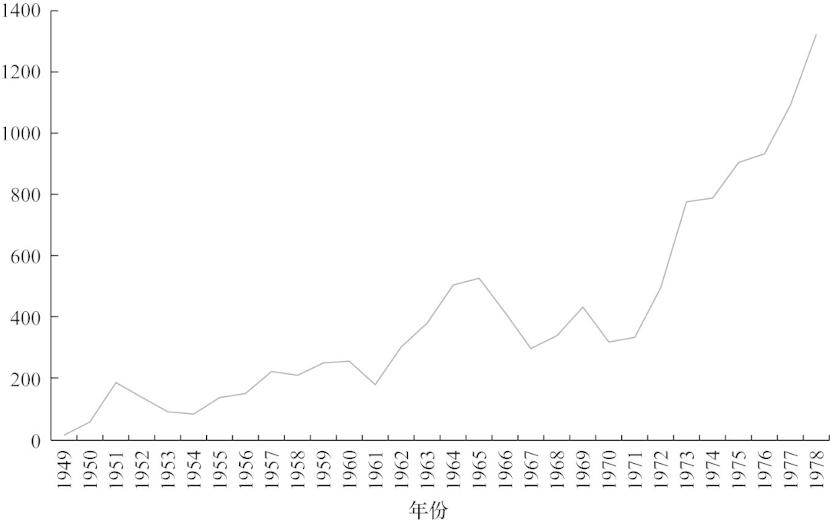
figure 1
After the founding of People’s Republic of China (PRC), everything was in ruins, and then major events such as the protracted War to Resist US Aggression and Aid Korea emerged one after another. However, at the national level, the urgency and significance of promoting Japanese studies have long been realized. Chen Hansheng once mentioned that in the mid-1950s, Liao Chengzhi talked about the establishment of an Asian Institute, and gave his own recommendations for Japanese researchers: Xie Nanguang for politics, Liu Minglei for economy, and Liu Sijing for constitution. In addition, he hoped to find outstanding candidates for Japanese religious studies and Japanese cultural education, especially for Japanese scientific progress research.
It can be seen that the balance between basic research and applied research is well balanced. However, many ideas have not been realized because of the internal and external situation constraints and changes facing the country. At that time, some Japanese research works, such as Liu Simu’s Post-war Japan, Zheng Senyu’s Japan Peace Movement, Zhang Xiangshan’s Japan, and Li Chunqing’s Introduction to Japan, were mostly "Japanese experts" among people in charge of specific work on Japan in different fields of the country. Their main contents were to reflect the new changes in Japan after the war, to oppose the re-arming of Japan by the United States, and to support the Japanese people in their struggle for peace and democracy. Of course, there are many achievements in basic research, such as Bibliography of China’s Novels Written by Sun Jiedi, Zhuqianzhi’s Zhuzi Studies in Japan, Japanese Ancient Studies and Yangming Studies, and History of Japanese Philosophy.
Statistically speaking, the reason for the first climax in 1964 was that on December 25th, 1963, the Foreign Affairs Group of the Central Committee and Publicity Department of the Communist Party of China submitted a report to the Central Committee on strengthening the study of foreign work, hoping to establish a number of new research institutions, and Mao Zedong gave the consent instructions on the 30th. By 1964, the Central Steering Group for International Studies and the Foreign Affairs Office of the State Council approved the establishment of a number of foreign research institutions under the Ministry of Foreign Affairs, the International Liaison Department, the Central Coordination Department and the Ministry of Education. The Ministry of Education, which has a unique advantage in foreign studies, acted quickly and issued the Notice on Issues Related to the Establishment of Institutions for Studying Foreign Issues in Colleges and Universities, and decided to establish institutions for studying foreign issues in 18 colleges and universities across the country. Among them, academic institutions involving Japanese studies began to appear in large numbers. In the following year, the Japanese Studies of Hebei University and the Japanese Studies of Northeast Normal University emerged as the times require.
It should be noted that these earliest Japanese research institutions in New China did have historical influence, geographical advantages, language foundation and other factors at that time. Once they were confirmed, they formed academic traditions and disciplinary advantages, and their influence was very far-reaching. Today, we can still see the shadow of the country’s layout in that year. It can also be clearly seen from the statistics that after the outbreak of "wg" in 1966, the number of academic articles on Japanese studies decreased significantly, and the number of Japanese research articles published in 1967 was only half of that published in 1965. It was not until the normalization of diplomatic relations between China and Japan in 1972 that the number of articles published in 1973 was more than double that published in 1971. The typical feature of this period is that it pays more attention to Japan’s economic and scientific and technological development, and the few Japanese research works are almost all concentrated in these two fields.
Li: What are the characteristics of Japanese studies in China after the reform and opening up? What are the influencing factors? At the beginning, Li Wei, a researcher at the Japanese Institute of Chinese Academy of Social Sciences, divided China’s Japanese studies into three stages after the reform and opening up:
The re-start in 1980s, the all-round development in 1990s and the mature period since 21st century. With the help of the Japan Foundation for International Exchange, Japanese scholars in China have conducted three large-scale surveys on Japanese research institutions and scholars in China. The first time was undertaken by the Japanese Institute of Chinese Academy of Social Sciences in 1984, and in 1985, the Japanese Studies in China was published. The second survey was undertaken by the China Japan Society and the Beijing Center for Japanese Studies in 1995, and the Japanese Studies in China was published in 1997. The third seminar was held from May 2008 to March 2009, which was undertaken by the China Society of Japan and the Japan Institute of Nankai University, and the Japanese Studies in China (1007-2009) was published in May 2010. Scholars have also systematically summarized the situation of Japanese studies in China for a long time. For example, in the early 1990s, Li Yu and others edited and published the Index of Japanese Studies in China (1949-1988), which systematically sorted out China’s Japanese studies. In recent years, domestic publications systematically summarized China’s Japanese studies, with very high quality. For example, the Japanese Studies in Contemporary China 1981-2011, edited by Li Wei, is a volume in the series Report on the Development of Philosophy and Social Sciences in China, and invited authoritative scholars in Japanese studies in China to summarize and summarize the achievements in Japanese political diplomacy, economy, social culture, philosophy and religion, and historical research.Considering that this book doesn’t cover the Japanese language and literature with the largest number of Japanese scholars in China, Wang Zhisong, a professor at Beijing Normal University, continued to improve and supplement it, and compiled and published Contemporary Japanese Studies in China 2000-2016, which summarizes some representative young and middle-aged Japanese scholars in China. According to the fields of linguistics and education research (Japanese linguistics, Japanese education, Chinese-Japanese translation), literature and art research (ancient literature, modern literature, fine arts, popular culture), social research (including society, economy, politics and diplomacy) and cultural research (including history, ideological history, folk customs and religion), this paper introduces the research achievements and development trends since the 21st century. The combination of these two books should be a very comprehensive summary of China’s current Japanese studies in various fields.
In the efforts to summarize Japanese studies in China, a series of works have been summarized and published from the perspective of Japanese studies magazines in China, such as Review and Prospect of Japanese Studies Magazine in China edited by Ma Xingguo and Cui Xinjing of Liaoning University, History of Japanese Studies Magazine in China edited by Lin Chang of Japan Institute of Chinese Academy of Social Sciences, and Magazine Perspective: Deepening Japanese Studies in China and Its Links with the World. In the summary and reflection on the specific fields of Japanese studies in China, the representative ones are in the field of Japanese history studies, such as Japanese History Studies in China, Sino-Japanese Relations Studies in China, Review and Prospect of Japanese History Studies in New China, etc.
Many scholars have summarized and analyzed the Japanese studies in China. For example, in November 1989, the Institute of Japanese Studies of the Chinese Academy of Social Sciences invited scholars to hold two symposiums to discuss the history and present situation, achievements and shortcomings of Japanese studies in China and future ideas. In 1990, the first issue of the Journal of Japanese Studies published the minutes of the meeting and articles by three scholars of the Institute of Japanese Studies of the Chinese Academy of Social Sciences: Luo Weilong’s Talk about Japanese Studies in China, He Qian’s My Humble Opinion on Establishing Japanese Studies in China, and so on. In recent years, there have been many similar summaries, such as Yang Dongliang, a professor at Nankai University, and Zhao Jin Ping, a researcher at Wuhan University of Technology, and Wang Jing, an analysis of the current situation of Japanese studies based on big data. In particular, Guo Xunchun of Japan Research Institute of Nankai University made a scientific summary of Japanese studies in China since the reform and opening up through statistical analysis of big data, especially in the aspects of the expansion of Japanese research teams in China, the increase of research institutions and the changes in the number of Japanese-related projects in the National Social Science Fund over the past 40 years.
On the basis of the above summary, we can see three characteristics of Japanese studies in China after the reform and opening up:
First, the number of Japanese research institutions and researchers in China is increasing continuously. Compared with the results of three surveys, the number of Japanese research institutions in China has increased remarkably. In 1996, there were 98 (73 research and 25 language teaching). According to the survey in 2009, there are 86 research institutes in Japan (62 research institutes and 24 language teaching institutes). According to the survey in 2018, there are 149 Japanese research institutions (96 research categories and 53 language teaching categories). It can be seen that the obvious driving force for the growth of the number of institutions is more language teaching, which has more than doubled in more than 20 years. According to the latest survey conducted by the Japan Institute of Nankai University in June 2019, the China Japan Society has 77 group members and 1,500 individual members. It can be seen that nearly half of the research institutions have not formally applied for group membership of the China Japan Society, and all provinces, municipalities and autonomous regions directly under the central government, including Tibet and Xinjiang Autonomous Region, have Japanese education in local universities. Compared with the situation at the beginning of the reform and opening-up, the Japanese research institutions and Japanese education in China were mainly concentrated in the eastern front-line areas, especially in Changchun, Shenyang, Tianjin, Beijing, Shanghai and other major cities. According to a survey conducted by the Japan Fund for International Exchange in 2018, there are 2,435 institutions involved in Japanese education in China, with 20,220 Japanese teachers and more than 1 million Japanese learners. On the basis of such a huge group, the number of Japanese researchers in China is constantly increasing.And the degree of education (the number of people with doctoral degrees) is constantly improving. In 1996, 52 of the 1,260 researchers had doctorates, accounting for only 4%; In 2009, 370 of the 1,040 researchers had doctoral degrees; In 2018, among the 3,450 researchers, 1,044 had doctoral degrees, more than 30%.
The number and proportion of doctoral graduates have increased rapidly, which is of course related to the increasing number of overseas students studying in China after the reform and opening up. With the improvement of’s comprehensive national strength, many scholars have returned to China to teach after obtaining doctoral degrees in Japan. At the same time, the change in the number of doctoral and master’s dissertations related to Japanese studies cultivated in China is also very telling (see Figure 2). This change is of great significance: first, the foundation of Japanese studies in China is constantly expanding, and the number of papers that choose Japan as their own direct research object or case comparison sample in various disciplines is increasing rapidly, which will greatly enrich the diversity of Japanese studies in different fields, with different methods and different perspectives, and help to produce better Japanese research results; Secondly, the master’s degree and doctor’s degree, especially the doctoral thesis, is often an important beginning of a scholar’s academic path. Considering the general law of the development of scholars’ academic path, the emergence of a large number of young scholars in more than ten years after entering the 21st century indicates that in the next 20 years or so, we will usher in a harvest period of continuous development of Japanese studies in China. Third, we should pay attention to the drastic changes in the number of graduation theses related to Japanese studies. Before 2000, the number of graduation theses related to Japan was very small, including one in 1986, one in 1988 and one in 1999, three in 1997, over 100 in 2004, reaching a peak of 544 in 2014, and then showing a cliff-like decline, and returning to the level of 2004 in 2018 and 2019.This can’t help worrying. Why is the quantity changing so dramatically? Is this just a unique change in doctoral and master’s dissertations, or is it a microcosm of the overall situation of Japanese studies in China?
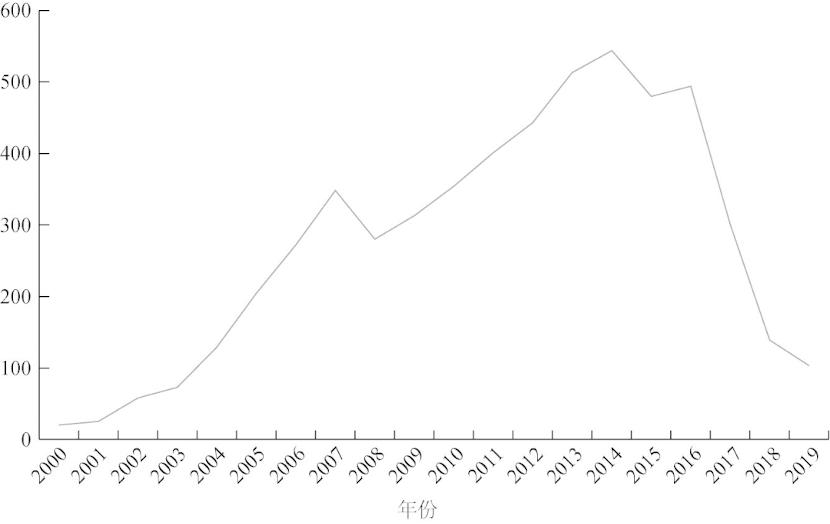
Figure 2
Second, the number of Japanese research achievements in China has changed dramatically. Due to the long publishing cycle of foreign-related research books in China, the overall number of publishing houses in different periods, serious regional imbalance and the difference in publishing funds, the change of the number of books published is not as fast as that of academic magazine papers, and it can more accurately reflect the trend change of the number of Japanese research in China.
According to the same standard, through the statistical analysis of the changes of academic papers in Japanese research circles in China from 1979 to now (see Figure 3), we can find that the changes in the number of master’s, doctoral and Japanese-related papers are still slightly better than the changes in the total number of Japanese research papers in China. After the latter reached 1,024 in 1979, it increased by nearly eight times to 8,172 in 2011, and began to decline in a cliff-like manner. By 2019, the number of Japanese research papers in increased by nearly eight times.
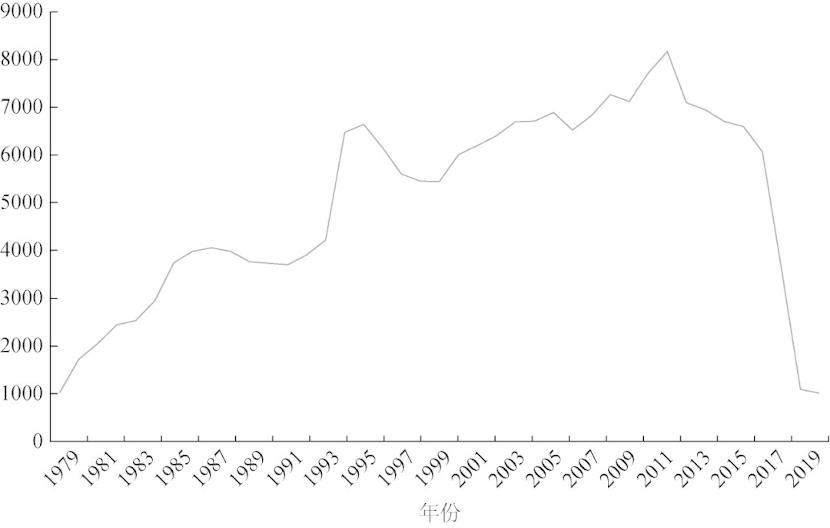
Figure 3
In order to ensure the reliability of the statistical results, after changing the retrieval methods, keyword retrieval is changed to topic retrieval, content summary retrieval and full-text retrieval, which basically presents a similar state of first promotion and then suppression, and the change trend is quite different from that of article title retrieval, which is not as drastic as the result of keyword retrieval (see Figure 4). Similarly, from 1979 to 2011, the growth reached a peak of about eight times, and then declined rapidly. By 2019, it returned to the level of the mid-1990s.
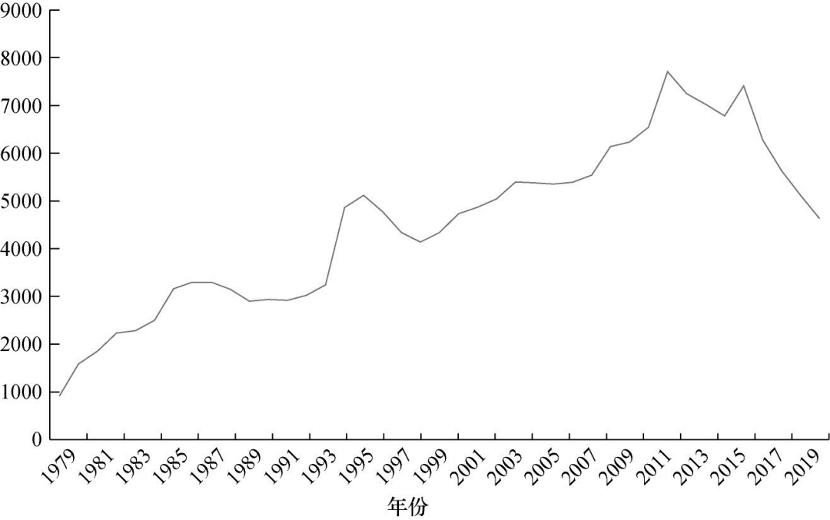
Figure 4
After the rapid growth of Japanese studies in China for more than 30 years, the reasons for the sudden decline in the number of papers are very complicated, which should at least include several aspects: First, the background of the development of China’s disciplines has changed, and the previous regional country studies have begun to tilt towards the development of disciplines, which has led to the academic transformation of many regional country studies scholars. An important example is that if China’s academic papers on American studies are counted according to the above research methods, almost the same situation can be found. From the steady development after the reform and opening up to the platform around 2010, it also experienced a rapid decline after 2013, and the number of papers in 2019 almost fell to half of the total around 2013; Secondly, this is also related to the intergenerational transformation of Japanese studies in China. Around 2010, most of the first generation of Japanese researchers trained by China after the founding of the People’s Republic of China began to live in retirement. The number of the second generation of researchers trained during the Cultural Revolution was small, and they gradually began to retire, which aggravated the above phenomenon. Thirdly, after the reform and opening up, China set off a climax of learning from Japan in science and technology, economic development, social governance and other aspects. However, following Japan’s entry into the "bubble economy" and subsequent "stagnation", especially after the 2008 Beijing Olympic Games, Japan gradually reduced and finally stopped its ODA to China.The focus of support for Japanese studies in China has also shifted from academic research to basic Japanese education. Especially after the "One Belt, One Road" initiative in China was put forward, the research on countries along the "Belt and Road" in domestic academic circles has developed by spurt. According to the above statistical methods, we can find that China’s academic papers on African studies are quite different from China’s Japanese studies and American studies. After the reform and opening up, the development has been sluggish, and it began to rise slowly in 2000. After 2014, there was a blowout. The number of papers in 2019 was almost double that in 2009.
Third, China’s Japanese studies are closely related to the objective needs of China’s economic and social development. At the beginning of reform and opening up, especially when Deng Xiaoping successfully visited Japan, the pun "as if pushing us away" ushered in the climax of China’s comprehensive study of Japan. A large number of Japanese books have been translated into Chinese, and China delegations from various fields have visited Japan to learn from them. But at this time, China’s Japanese studies were not fully prepared, and there was no specific planning and overall planning at the national level. The establishment of the Institute of Japanese Studies of the Chinese Academy of Social Sciences, which is now an important center of Japanese studies in China, is a good example. According to the memory of the director of the institute at the beginning of its establishment, he was originally going to build the Soviet Union’s Eastern European Institute, but he gave up because he received a complete institute from the International Liaison Department. In January, 1980, he accompanied the then vice president of social sciences in China to the United States for academic exchange. At the meeting of Brookings Institution, the official township suddenly announced that China Academy of Social Sciences had established the American Institute and the Japanese Institute, with Li Shenzhi and Where as the directors respectively. Prior to this, it was decided in a hurry without discussion and approval by the party group of China Academy of Social Sciences, and without filing by the Central Organization Department. Because of the limitation of hukou and other issues, it is very difficult to recruit researchers in Japan. No one can but invite Liu Yingchun, a Japanese major graduate of Peking University before the Cultural Revolution, from the International Liaison Department, and even find four veteran cadres who graduated from the Puppet Manchukuo University. After two years of hard work, a scientific research team can be established.
At that time, Hu Yaobang, the national leader, was very concerned about Japanese studies, and even wrote to Zhang Shengzhen, the author of A History of Sino-Japanese Relations, urging people and readers who study history to pay more attention to the great benefits brought by the restoration and development of friendly relations between China and Japan after the normalization of diplomatic relations for more than ten years. This undoubtedly further promoted the development of Japanese studies in China. However, does this mean that Japanese studies in China are deeply influenced by politics? Many Japanese and western scholars have criticized the lack of independence of China’s academic research. We can compare the changes in the number of Japanese-related reports in People’s Daily (see Figure 5) with the trends of the previous academic papers on Japanese studies in China to see if there is any correlation.
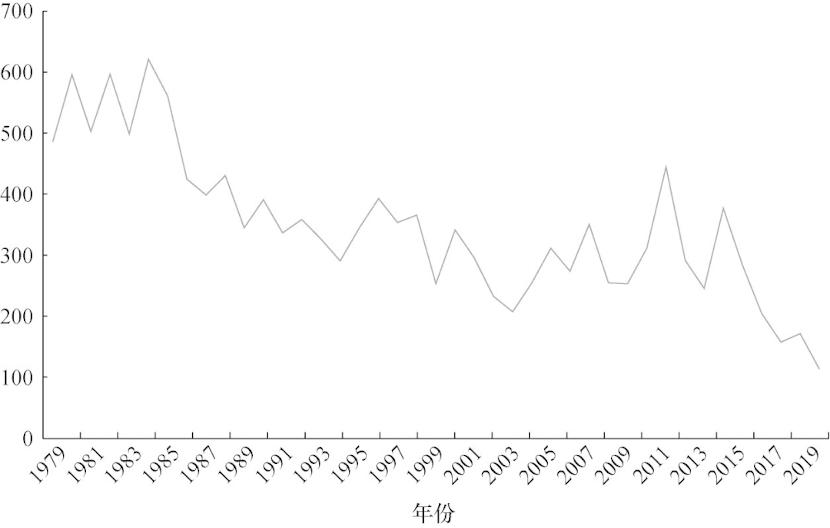
Figure 5
Obviously, there is almost no correlation between the two most of the time. Of course, the foreign-related research of any country can’t have nothing to do with the policy trend and public concern of this country. The key is the size and closeness of this correlation. Therefore, taking the issue of Yasukuni Shrine, which has had an important impact on Sino-Japanese relations in the past 40 years, as an example, this paper analyzes the frequency and trend of the reports on the issue of Yasukuni Shrine in People’s Daily (the overwhelming part of which is the statement and criticism of Japanese leaders’ visits to Yasukuni Shrine, but it does include the affirmation of some Japanese leaders’ statements not to visit Yasukuni Shrine, and the criticism of some Japanese political parties and people on Yasukuni Shrine), and at the same time, makes statistics on the relevant research published by Japanese research circles in China during the same period.
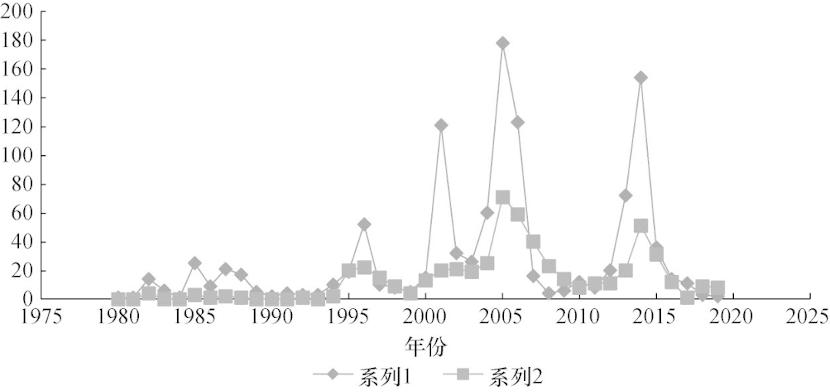
Figure 6
From the above statistics, it can be clearly seen that the coverage of the Yasukuni Shrine in People’s Daily has changed greatly, and the years when the Prime Minister visited the Yasukuni Shrine in Japan are generally very high. There are also fluctuations in the study of the Yasukuni Shrine in Japanese studies in China, but the range of change is relatively stable compared with the government’s position. In the past 40 years, academic circles have not published any special articles about the Yasukuni Shrine for about 10 years, which is far less than the number of statements made by the government. In the other 10 years when the government made few statements, the number of articles published by scholars on the study of Yasukuni Shrine exceeded the number of government statements. This statistical result shows that the research on Yasukuni Shrine in China is relatively stable, and strictly speaking, it has never been an academic hotspot in the field of Japanese studies in China. This also shows that it is difficult for the government to encourage or ask Japanese researchers in China to follow suit with government policies through various means.
02
Japanese Studies in Contemporary China
Li: How do you evaluate the authority and influence of China’s Japanese studies? Does China’s Japanese studies have the right to speak in international academic circles?
Chu: While we are rejoicing at the blooming of Japanese research institutions in China, the growing number of researchers and the fruitful academic research, we must have some sense of crisis. According to the statistics of the Japanese Government Tourist Office, in 2019, the total number of Japanese tourists visiting China reached 16,775,600 (including 9,594,300 in Chinese mainland, 4,890,600 in Taiwan Province and 2,290,700 in Hongkong). The Japanese side specifically mentioned that at present, Chinese mainland’s travel to Japan has been characterized by "FIT" ("individual direct selling" means free travel), and the pursuit of independence, depth and individuality has become a general trend.
There are huge groups in China who are so interested in Japan, and they urgently need to get more comprehensive, detailed and accurate information about Japan. It is reasonable to say that this time should be a great driving force for the development of Japanese research in China, but on the contrary, the total amount of Japanese research results in China has dropped sharply. Even during the period of 2000-2010, when China’s achievements in Japanese studies developed greatly, did the academic circles in China produce achievements that were recognized by the academic circles of Japanese studies in the world? Is it possible to help people understand this "distant neighbor" more objectively through research? In 2005, after the birth of Chrysanthemum and Knife, the book suddenly appeared on the best-seller list in Chinese mainland. At that time, there were more than 10 translated versions in the market, and the sales of various versions reached 70,000 copies within one year.
The upsurge caused by an academic work half a century ago has something to do with the problems in Sino-Japanese relations that attract people to try to understand Japan, but it cannot be denied that this has something to do with the fact that Japanese scholars have not put forward representative Japanese research results that convince the public, which needs to be considered from the following four aspects.
First, China’s Japanese studies are essentially regional country studies. At present, there is a huge and urgent strategic demand for regional country studies in China, which has a very good academic accumulation and development foundation, but regional country studies themselves are facing many problems. Although the research areas and countries are different, as a research field, does regional country research have its own research scope and research methods? What is the relationship between the research on regional country politics, regional country history, regional country economy and regional country society and the research on political science, history, economics and sociology in the existing discipline system?
Taking Japanese studies as an example, are the criteria for judging the quality of China’s Japanese political studies consistent with those for political studies? Or do you have your own independent criteria that are different from political science research? There are two ways to test the status of Japanese studies in China in different disciplines.
Founded in 1958, the Book and Newspaper Information Center of Renmin University of China is the earliest information provider engaged in the collection, sorting, editing and publishing of humanities and social sciences documents in New China. The series of Copying Newspapers, a monthly magazine edited and published, has long-term and regularly selected excellent papers from various disciplines, which has high academic and scientific research value, wide coverage, large amount of information, scientific classification, rigorous screening and reasonable and complete structure. Among all kinds of literature and information materials, We choose the representative subjects in Copying Newspapers and Materials, and count the research results related to Japan from a long period of time to see what position Japanese studies, as regional country studies, occupy in different disciplines. In order to better understand the composition of this proportion, we can choose American studies in regional country studies as a reference. It should be noted that, due to the complexity of disciplines such as politics, history, economics, literature and philosophy, data statistics are not typical. Therefore, two disciplines, which is more closely related to regional and national studies, has been selected, such as international politics in politics, world history in history, world economy in economics, foreign literature in literature and foreign philosophy. At the same time, considering the existence of a large number of comparative studies in various related disciplines, we don’t use keywords and topics to retrieve, but take content summary retrieval, which proves to be more relevant after comparing the results. The specific statistical results are as follows. (See table below)
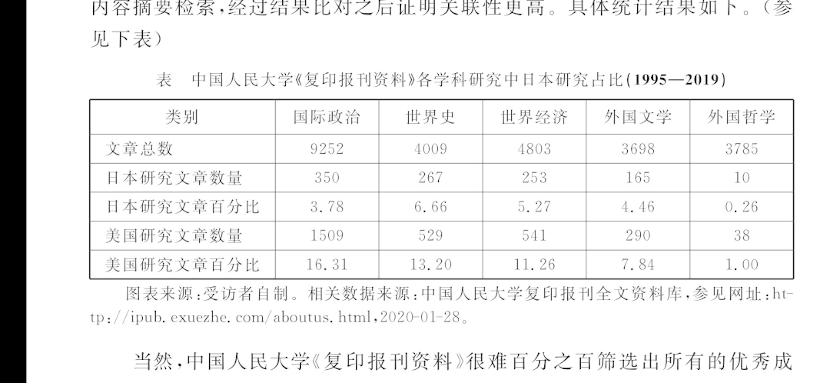
Of course, it is difficult for China Renmin University to screen out all the outstanding achievements in "Copying Newspaper Materials", and whether this statistical method can accurately reflect the real influence of Japanese studies in various professional studies is worth pondering, but the large samples in the past 24 years can still explain some problems. The statistical results show that China’s study of Japan is more confined to the study of Japan’s uniqueness and his own discourse system. Compared with China’s American studies, China’s Japanese studies have great influence on various disciplines. This reminds us that Japanese studies in China need to be more professional. The academic achievements of Japanese studies in different fields need to be recognized by colleagues in the same discipline in terms of raising the awareness of basic questions, using basic concepts and developing basic research methods, and there is the possibility of dialogue to attract more attention. At least, there can be no fallacies that are considered as low-level by professional disciplines. In layman’s terms, it is impossible to speak layman’s words in this discipline.
If it is suspected that the above statistics are not enough to explain the influence of Japanese studies in China in the current academic circles, there is another way to conduct a similar test, that is, the citation rate of articles. Among the nearly 210,000 Japanese research articles recorded in China HowNet since 1917, what kind of works have the highest citation rate for academic articles with Japan as the key word? Excluding the translated articles by Japanese scholars, and then excluding the articles on science and engineering, we can find that the article Comparative Advantage and Development Strategy: A Re-interpretation of "East Asian Miracle" by Lin Yifu, Cai Fang and Zhou Li has the highest citation rate, followed by Yu Kehong and Mu Shunbi’s A Comparative Study on the Physique of China, the United States and Japan, and the third place is Ji Weidong’s The Orientation of Legal Profession: Japan’s Practice of Reforming the Power Structure.
Among these authors, only Ji Weidong is regarded as a Japanese scholar. Although he is a jurist first, his main research fields and published works focus on sociology of law, comparative law, Asian constitution and judicial system. It can be seen that in China’s Japanese research achievements, professional discipline researchers have a greater influence.
Secondly, China’s Japanese studies have gone through arguments about emphasizing methods and historical materials. When talking about historical research methods, Zhou Yiliang once pointed out, "After liberation, in order to correct the past, historians only focused on historical materials and regarded historical materials as history, so it was necessary to emphasize theories and viewpoints, focus on the big picture and understand them. However, it ignores the detailed and in-depth study of specific events, people and systems, so it slowly flows into the air and becomes a common problem. " Of course, Mr. Zhou hopes that the theory and the use of historical materials can complement each other. However, in view of the impetuous trend of academic research after the "Cultural Revolution", he emphasizes the solid study of first-hand historical materials and praises Mr. Fan Wenlan’s academic attitude of "sitting on the bench for ten years is cold, and the article is not empty". After more than 30 years, has this phenomenon fundamentally changed in Japanese research circles? The book Real and Virtual Images of Japanese Studies with Chinese Style: A Preliminary Investigation on Rebuilding the Academic Tradition of Japanese Studies in China is a very important work for China’s thinking on the methodology of Japanese studies.
He made a systematic comment on the achievements (called real images in the book) and existing problems (virtual images) in the research fields of Japanese ideological history, Japanese history and modern Sino-Japanese ideological and cultural exchange history. It reveals that the awareness of statecraft, principle and original works in China’s research field on the history of Japanese thought is constantly increasing, which is of great significance for "rebuilding the academic tradition of Japanese studies in China" and consolidating the discipline foundation of Japanese studies in China. Liu Yuebing repeatedly called on China’s Japanese studies to "return to the original book". He pointed out that if we don’t make efforts to interpret and translate the "original classics" and build systematic historical materials of Japanese studies in China, in short, if we don’t rebuild China’s academic tradition of Japanese studies on the basis of the original classics, it will be difficult to deepen the relevant research.
With the emergence of a large number of young and middle-aged researchers who are proficient in Japanese or even in many foreign languages including Japanese, and with the opening of archives and the convenience of traveling to and from Japan, Japanese studies in China have paid more and more attention to solid first-hand information research, and a number of rigorous and solid research works and papers have emerged based on long-term academic accumulation. In recent years, academic circles have paid special attention to the collection, translation and collation of basic materials, and many large-scale data sets have been published. For example, The 15-volume Compilation of Archives of Manchuria Railway edited by Xie Xueshi, a researcher at Jilin Academy of Social Sciences, the 60-volume Compilation of Labor Archives of Japanese Forced Abduction of China to Japan edited by Shen Qiang, director of China People’s War of Resistance against Japanese Aggression Memorial Hall, and the 59-volume Compilation of September 18th Incident of Japanese Invasion of China and 51-volume Compilation of July 7th Incident of Japanese Invasion of China edited by Tang Chongnan, a researcher at the Institute of World History of China Academy of Social Sciences. Xu Yong and Zang Yunhu, professors of Peking University History Department, edited 46 volumes of Series of Historical Materials on Japanese Aggression against China, and so on, many of which were the painstaking efforts of scholars in related fields who gathered the strength of all people to fight for poverty. In addition, at present, the state attaches importance to the introduction of basic materials for academic research, and sets up special projects or funds to purchase complete sets of large-scale original materials from abroad, providing necessary conditions for solid academic research. It is reasonable to say that the publication and purchase of key "original" data sets in related fields should promote the development of related research in this field, which is reflected in the continuous emergence of a series of papers or monographs. Have the problems in historical materials fundamentally changed?Scholars who study the history of Sino-Japanese relations all know that the written conversation between Okauchi Huisheng, the former vassal of Takasaki, and the Japanese embassy staff in recorded the Okauchi Document, which was highly praised by researchers for its large number of participants, long duration and rich information. However, because it is scattered in many places in Japan, and the number is huge, few people can get a glimpse of the whole picture. Wang Baoping, a professor at Zhejiang Gongshang University, finally collected and compiled the Okauchi Documents collected in Waseda University and Dadong Culture University in Japan into eight volumes for color photocopying and publishing, and named them Okauchi Documents, which were collected by Japanese scholars in the late Qing Dynasty.
This should be a good thing for the academic community, and it has accomplished a feat that Japanese scholars who are best at sorting out information have not completed. Unfortunately, since its publication in 2016, only one master’s thesis and two articles have cited this set of books, one of which is Wang Baoping’s own work. On the contrary, after the publication of this set of books, it became a topic among scholars in the modern history of China and the history of Sino-Japanese relations in Japan, and set off a research upsurge. This phenomenon is not a special case. The Compilation of Archives of Manchuria Railway, edited by Xie Xueshi, took more than 50 years to complete the great project of more than 12 million words if it was calculated from the task of compiling historical materials of Manchuria Railway, a national planning project in 1958. However, only 45 academic research papers were searched and cited in China HowNet. It’s a little comforting that this set of precious first-hand materials has been cited in the master’s and doctoral dissertations, reaching 109. I sincerely hope that the younger generation of Japanese scholars will always adhere to this trend of paying more attention to the original classics.
Thirdly, the quality of Japanese studies in contemporary China needs to be improved. There are a large number of books and papers related to Japan in China every year. How many of these works are really studying Japan, finding new materials, asking new questions and summing up new laws? Or are you just describing and imagining Japan? How many are eager to follow the trend and pick up people’s wisdom? Professor Ando Hikotaro of Waseda University, a Japanese scholar of the older generation who studies China, once mentioned that many people in China have rich Japanese knowledge, which even surprised the Japanese. At the same time, he also pointed out very frankly: "The knowledge accumulated from experience is not systematic and has not been applied in Japanese studies. My real feeling is that there is a contradiction between understanding Japan and studying Japan, and this contradiction has not been completely overcome. "
Before the 21st century, due to the constraints of China’s comprehensive national strength, the differences in the development stages between China and China, and the overall openness of, the number of Japanese academics who were proficient in using Japanese and had the opportunity to go to Japan for a long time to collect information was still relatively small. Those travel notes of observing the customs, the translation and introduction of new knowledge and phenomena in many fields in Japan, and the arrangement of exchange records between Chinese and Japanese scholars laid an important foundation for Chinese to broaden its horizons at that time, train the younger generation of scholars and develop academic research thereafter, which should be recognized. However, with the development and changes of the times, the great development of globalization, the rapid development of information electronization, knowledge dissemination and retrieval methods, the asymmetry in knowledge acquisition has changed fundamentally. Facing the booming interdisciplinary, interdisciplinary and multilingual academic research, it is difficult to produce works that satisfy the Japanese academic circles and the people of China.
In 2002, on the occasion of the 30th anniversary of the normalization of diplomatic relations between China and Japan, Ma Licheng, a commentator of People’s Daily, wrote an article in Strategy and Management, calling on all circles to re-examine Sino-Japanese relations to avoid the deepening of hostile ultra-nationalism between the two countries and falling into a vicious circle, and put forward a "new thinking on Japan" that should put historical understanding in a secondary position.
Subsequently, Shi Yinhong, a professor at China Renmin University, also published an article, systematically expounding Ma Licheng’s "new thinking". This conclusion has broken some long-standing consensus of Japanese studies in China, causing an uproar. Many Japanese scholars have written articles to argue, and the pen and ink lawsuit even reached Japan for a time. In the criticism of Ma Licheng and Shi Yinhong, there are some strong objections that they are not experts on Japanese issues, and their arguments are too naive and lack common sense. Academic contention is originally the driving force and normal state of academic development. The differences of specific viewpoints should be competed by putting facts and reasoning, and should not be judged according to the experts in which field the viewpoints are put forward. Another example, according to the statistics of China Knowledge Network, since the 1970s, Japanese academic circles have published about 1,035 articles about Diaoyu Island, of which, how many have provided new knowledge and new ideas, and it is not easy to draw conclusions. Aside from those patchwork and even flawed works, most of them use materials from China and China, including ancient nautical charts to contemporary archives. But can the study of the Diaoyu Islands issue be made clear only by the data of China and Japan? In 2005, Guo Yonghu, a professor at Jilin University, published "A Historical Investigation on the" American Factor "in the Diaoyu Islands Dispute between China and China", which is still the paper with the highest citation rate in Japanese academic circles.
In 2015, Zhang Sheng, a professor at Nanjing University, presided over the major project of the National Social Science Fund "Literature Collection on Diaoyu Islands". By April 2017, the project had successively collected and published 10 volumes of Literature Collection on Diaoyu Islands, with a word count of 4.33 million, including Chinese, Japanese and western languages, specifically, American Diplomatic Relations Documents, British Diplomatic Archives and Japan.
On the basis of English archives, Qiu Mengying, a student directed by Zhang Sheng, wrote his graduation thesis "The Diaoyu Islands Issue from a British Perspective" in 2018, and Chen Haiyi published "The Disposal and" Return "of the Ryukyu Islands after World War II: An Investigation from a British Perspective". The development of these new fields and new materials is a very good impetus to the study of Diaoyu Islands.
Fourthly, the research mentality of China’s Japanese studies. Looking back at the history of Japanese studies in China, we can find that Zheng Shungong of Ming Dynasty, Huang Zunxian of Qing Dynasty and Dai Jitao of Republic of China all mentioned that China had some special mentality when facing Japan, which was not conducive to our calm and objective research. So, do we have similar problems now? Zi Zhongyun, a former director of the American Institute of China Academy of Social Sciences, is not an expert on Japanese issues, but her father was Zi Yaohua, who studied in Japan for ten years and was educated by Kyoto University. Based on his father’s experience, Zizhongyun proposed that Japanese studies on China are deep and detailed, and have a long history and are consistent. However, in comparison, China’s research on Japan is always underdeveloped, and it always stays at a shallow level. Investigate its reason, she put forward three: "First, emotional. The study and understanding of a foreign country is often confused with state relations. Be a’ friend’ when the relationship is good, and look at the advantages, otherwise it will be the opposite … Second, regard Japan as a’ setter’ … Third, it is pan-political and highly pragmatic. At a deeper level, Chinese people can’t get rid of the mentality of claiming to be the source of culture in Japan. "
For Japanese scholars in China, these criticisms are very sharp. Objectively speaking, they are not suitable for all Japanese scholars in China, and they are not suitable for all fields. However, they are clearly reflected in some scholars in some fields. We should listen carefully to Zi Zhongyun’s harsh advice and promote China’s Japanese studies calmly, objectively and solidly. Practically speaking, the national cultural center, or in the words of the German philosopher Heidegger, is the "foresight, prophet" in human thinking, which exists to some extent in the subconscious of any country and every scholar. China and Japan have a long history, and they have similar cultural elements and many common spiritual pursuits. Therefore, when studying Japan, it is easier to have the thinking tendency of "judging others by themselves". Mizoguchi Yuzo, a Japanese scholar, pointed out that there is a tendency in Japanese China studies when discussing the research methods of China studies. "When understanding China culture as a foreign culture, on the one hand, it produces a sense of closeness, and at the same time it creates a negative result that hinders the understanding of differences."
It should be said that this summary is very incisive, and the same thing happened in Japanese research circles in China. Therefore, when studying Japan, especially when observing Japan closely, we should form an instinctive reaction, and try our best to avoid influencing our objective judgment because of personal preferences, emotional factors and even the trend of public opinion.
Of course, there is another opposite mentality in China’s Japanese studies. Especially at the beginning of the reform and opening-up, because Japan was the goal of China’s learning and catching up, some scholars translated and introduced various research results from Japan, which directly became a prescription for China. In response to this phenomenon, Luo Weilong, former director of the Institute of Japanese Studies of the Chinese Academy of Social Sciences, pointed out in 1990 that "in research work, there is a tendency to be one-sided and metaphysical. After the war, Japan did have a lot to learn from in economic management, education development, national culture development, scientific and technological development and even administrative management. However, when studying these problems, we should not only study them according to books and materials such as principles and policies, but also actually examine the problems encountered in the process of putting them into practice, so as not to’ idealize’ these experiences. "
With the development of China and the increasing exchanges between China and Japan, the misunderstanding between them is decreasing, but there is a new "ignorance of food". Some China scholars use the existing research methods in Japan as a model, and constantly introduce new theories and research terms. Before there is a suitable Chinese expression, some Chinese professional words directly use Japanese characters, so that readers are at a loss. In view of this situation, Yang Dongliang pointed out very objectively that "the diversification of research methods broadens the cognitive horizons of researchers and enriches the means to solve problems, but it also increases the difficulty of determining the standard of value judgment. The urgent problem to be solved in reality is how to avoid introducing new theories and methods on the surface, but in fact, it is the doctrine of taking things mechanically and empty talk. "
A new theoretical method should not be simply a novel narrative way, but should be able to confirm or disprove the existing research and open a new perspective to observe Japan. What is more serious than this kind of mechanical borrowing doctrine is that very few mathematicians blindly follow the academic viewpoints in Japan, do not seriously examine their original materials, argumentation process and logical consistency, simply quote and repeat other people’s conclusions, and lack the habit and ability to discriminate. This style of study should be highly vigilant in the field of Japanese research. Liu Deyou, a former vice minister of culture, criticized many times the so-called "Japanese cultural particularities" to explain the Japanese government’s visit to the Yasukuni Shrine. He reminded Japanese scholars in China that "Japanese studies in China, including Japanese culture, should be rooted in the academic fertile soil of China, and should have their own views based on science, instead of simply imitating and copying Japanese local related disciplines.".
Some criticisms by Cheng Song, a professor of history in Peking University, are even more direct. China scholars should "take foreign historical experience and lessons as the stones of other mountains, use them for our own use, distinguish, choose, sort out and explore, rather than swallow the dates, dwarf themselves or worship indiscriminately". All these problems are not unique to Japanese studies in China. Looking at Xu Xingqing, a Taiwan Province scholar in China, and Jin Chunmei, director of the Japan Institute of Korea University, summing up the current situation of Japanese studies in Korea, we can find that how to overcome scholars’ personal emotional preferences and objectively study Japan is a test for scholars from various regions and countries in East Asia.
03
Prospects of Japanese Studies in China
Li: As you have analyzed, there are many achievements in Japanese studies in China, but the problems cannot be ignored. What do you think is the prospect of Japanese studies in China, and what efforts should be made?
Chu: Japanese studies in China have a very long history, and a large number of outstanding researchers have been trained and achieved fruitful results. With the development of China’s economy and society, more and more scholars realize that Japan is an important neighbor of China. Although it is overtaken by China in economic aggregate, it will still play a decisive role in the world, especially in Asia, for a long time to come. A careful study of Japan is not only of great academic value, but will, as always, provide important reference for China. Based on the history and present situation of China’s study of Japan, we can make some prospects for the future study of Japan in China.
First, we should further sort out the tradition of Japanese studies in China and summarize the advantages and characteristics of Japanese studies in China.
Japanese studies in ancient China were more about imagining, collecting and recording information about Japan, while researchers in modern times were more about learning, translating and criticizing Japan out of a sense of urgency to save the country. After the founding of People’s Republic of China (PRC), they really laid the foundation for Japanese studies. They not only had a strong motivation to study Japan, a very solid China cultural background, but also received very strict modern academic training. The experiences of Zhou Yiliang, Wu Tingtang and Zou Youheng are very representative. Zhou Yiliang was born in a scholarly family, and received a good traditional culture education and foreign language training since he was a child. In college, he was instructed by famous teachers such as Zhicheng Deng, Hongye and Chen Yinque. When he majored in Japanese language and literature at Harvard University, he studied under Serge Elisseeff, known as the "father of western Japanese studies", and Ye Liseeff himself studied in the present University of Tokyo from 1908 to 1914. It is worth noting that Ed-win O Reischauer, a famous Japanese studies scholar in the world, was also a disciple of Ye Lisui and a brother of Zhou Yiliang. After the founding of the People’s Republic of China, Zhou Yiliang taught in Tsinghua University and Peking University successively. According to Mr. Zhou’s own statement, "in the past 60 years, I can be said to have experienced three different stages of training: Ganjia Puxue, Western Modern History and Marxist History. In my opinion, these three types of training have one thing in common.That is to say, history must be true or as close as possible to the truth, and it is not allowed to practice fraud or fabricate tampering. Only true history can become a’ teacher of the future’ and play the role of reference, reference and even education. The most fundamental attitude and method to study history is only four words: seeking truth from facts. How can we seek truth from facts? A qualified historian should see both trees and forests; Can be from this to that, from small to big; See the relationship between different fields such as politics, economy, society, culture, etc., see the internal relationship between various historical phenomena, and see that history is developing dialectically. " Influenced by his uncle in his childhood, Mr. Wu Tingxuan has a good knowledge of foreign languages. In 1929, he entered Peking University and studied under Mr. Xu Deheng and Mr. Chen Qixiu. In 1933, he entered the history department of Kyoto University in Japan and studied under the first president of the Oriental Society of Japan, Haneda Heng. He taught at Sichuan University, Wuhan University and Nankai University successively. As early as 1961, Mr. Wu was keenly aware of the "Eurocentrism" tendency in the study of world history and advocated adhering to the overall study of world history. What is more commendable is that Mr. Wu believes that "it is unnecessary for some people to suggest an Asian-centered world history system because they oppose Eurocentrism." He advocated that "world history is to study human society as a regular and unified process". The History of Japan, written by Mr. Wu, lasted for 20 years, with millions of words, which reflected the position and viewpoint of China scholars on Japanese history research.
Mr. Zou Youheng went to Japan to study in 1932. In 1936, he entered the Department of Literature of Tokyo University and majored in Western History. He studied under Toshiki Imai, Chengping Hirata and Yuren Goro. Shigeki Toyama was Mr. Zou’s brother, while Kiyoshi Inoue was his classmate. After returning to China, he taught at Northeastern University and Northeast Normal University successively. Mr Zou believes that China’s foreign studies certainly include Japanese studies. "There has always been a problem that one tendency conceals another. In the past, it was impossible to talk about the good things in capitalist countries, but in recent years, there has been a tendency to talk more about the advantages and ignore the negative aspects of the modernization of capitalist countries. Although there are problems with researchers here, the most important thing is that the past policies and routes and artificial taboos are still at work. " Based on his own research experience, Mr. Zou appealed to the situation that the Japanese historical research field was greatly influenced by the Soviet historical view and the Japanese historical view at that time. "We want to study Japanese history with China characteristics and take our own way, and the premise is seeking truth from facts. No matter who advocates it, as long as it is reasonable and well-founded, it should be affirmed, instead of blindly following anyone or school. To have your own research and summarize your own views, to exaggerate, to establish your own system and create a Japanese history school in China, these should be long-term goals. ".
From the experiences and reflections of these predecessors in Japanese studies, we can see the origin and hardships of China’s Japanese studies. They all emphasized the style of seeking truth from facts and the tolerant attitude towards research methods. To establish your own research system and methods, the premise is to clearly know what others have done and know the advantages and disadvantages of various systems and methods. To introduce or use a research method or analysis tool, we need to have a comprehensive, systematic and accurate grasp of it, sort it out logically, verify it with a large number of cases in different times, and compare it through differences between heterogeneous objects. It is very difficult to put forward a new concept and establish a new analytical method. How easy is it to hope that China can establish its right to speak in the field of Japanese studies in the world in a short time? As Li Wei said, we "still have a long way to go to construct China’s Japanese research paradigm".
Secondly, due to technological progress and more comprehensive language and theoretical training, it is possible for the younger generation of Japanese researchers in China to make greater achievements in the interpretation of the original classics and the application of methods. In the past, using first-hand materials mainly refers to reading original manuscripts, traditional archives, newspapers and magazines of different times and other paper materials or films in libraries and databases. Due to the large-scale electronic digitization and the continuous improvement of transmission speed, various databases and electronic resources can be conveniently used thousands of miles away through the network. For example, the study of Japan’s politics, law, economy, society and so on can not be separated from a comprehensive investigation of the formation process of Japan’s national policy, and more attention should be paid to the massive raw materials that Japan has made public. Japan has opened three complete databases related to parliament: one is the imperial parliamentary proceedings database, which mainly contains parliamentary records before the war, and all the words and images discussed from November of Meiji 23 (1890) to March of Showa 22 (1947) can be retrieved and viewed; The other is the Japanese Parliament Minutes Database, which contains parliamentary records after the war. From the first parliament in the 22nd year of Showa (1947) to the present, all the words and images discussed in the Japanese Parliament can be searched and read. The information in these two databases is accurate and true, even including the pet words of parliamentarians in different times and the applause at the meeting. Moreover, they are completely free without any password and can be downloaded at any time. The third is the index of Japanese laws, including the 19th year of Meiji (1866).In February, the bills submitted to the Japanese parliaments and the revision and abolition of laws and regulations, the deliberation process of all bills, and so on.
Such convenient and authoritative materials were seldom used by Japanese academic circles in China before. For example, Sun Lixiang, a professor at Huazhong Normal University, made good use of these materials in the study of post-war compensation, and Liu Jianping, a professor at China Communication University, made good use of them in the study of Diaoyu Islands, and finished high-quality academic papers. A new generation of young scholars accept and use these databases more quickly and actively. Taking the above three databases as examples, For example, Tian Ye of Jilin University (directed by Professor Liu Yibin) wrote a doctoral thesis on Japan’s compensation diplomacy after World War II (1945-1977), Shu Fanghong of China Academy of Social Sciences (directed by researcher Cui Shiguang) wrote a doctoral thesis on pacifism in Japan after World War II, and Zhang Jianwei of East China Normal University (directed by Professor Cui Pi) wrote a doctoral thesis on the "Okinawa Compact" between the United States and Japan. And China Academy of Social Sciences Liu Jiyue’s master’s graduation thesis "Abe’s Cognitive Research on China: A Survey Centered on the Proceedings of the National Assembly (2013-2018)", which provides solid arguments for the thesis and has an increasing trend in recent years, which is really gratifying. In the traditional research habits, the painstaking interpretation and direct quotation of original classics and first-hand materials are the basis and foundation of academic research. But will the original code and first-hand information "see for themselves"? Even the works or records of the parties, due to time differences and various taboos, cannot guarantee that their narrative is the truth of history. Similarly, in the face of the same words,Different times, different countries and even the same interpreter have different interpretations in different periods of their academic career. Just like natural science research, facing the same research object, different scientists need to use different instruments and different ways to do research. The state of the object described by human eyes and the composition of the object described by electron microscope are definitely very different, but it is meaningless to argue about which is right or wrong. The human eyes and electron microscope can actually be understood as research methods, and we need more explanatory tools to complete our understanding of the development law of the world and human society at different levels. Joseph nye once reminded us: "Theory or history alone is not enough to explain the problem. Historians who advocate understanding problems by narrating facts have not told us the principles they follow and hide when choosing facts. Political scientists have also made the same mistake. They are isolated and addicted to the maze of abstract essentials and take the ideas in their minds as reality. We can only avoid such mistakes by going back and forth between history and theory. "
The efforts of the younger generation of Japanese researchers in China are very exciting. Based on the original books and first-hand materials, they boldly try to adopt more scientific research methods, revealing many inspirations that were difficult to get through partial and simple reading of the original text, asking interesting questions and giving very convincing answers. For example, Zeng Jing, an associate professor at Shanghai International Studies University, used the research method of political linguistics based on text data modeling to sample and mine the text data of policy-related texts based on statistical principles. The sample is selected from the Japanese Prime Minister’s official residence’s database "The Prime Ministers’ Speeches on Current Policies and Beliefs". The policy speeches outline the basic principles and policies of the government in this year, while the belief speeches fully show the prime minister’s personal political ambitions and strategy of governing the country, which is the most important embodiment of the Japanese government’s governing philosophy and policy preferences. At the same time, the speech occasions are relatively consistent and the frequency of speeches is evenly distributed, which is especially suitable for analyzing the ideological changes of the Japanese government. The sample includes 172 congressional speeches delivered in the 70 years after the Second World War (September 1945 to February 2015). After statistical analysis of word frequency and correlation analysis of policy keywords by software, a regression model is established with the actual gross national product (GDP) growth rate as the dependent variable and the annual average frequency of all policy keywords in the same period as the independent variable, and many enlightening conclusions are obtained. "Japan’s security policy preference and economic policy preference are generally negatively correlated. When economic means can effectively promote economic growth,Security policy changes tend to ease; When the improvement effect of economic means on the economic situation is not obvious, the Japanese government tends to raise the level of security defense. "
If only through the traditional classic analysis, a single scholar can’t handle such a huge amount of data, let alone find long-term regular characteristics. Similar efforts can also be reflected in Zhang Jianli, a researcher at the Institute of Japanese Studies of the Academy of Social Sciences, on Japan’s great power consciousness. The first-hand historical materials he chose were the database of diplomatic public opinion survey published by the Cabinet Office of Japan and the database of Japanese politics and international relations published by Akihiko Tanaka, Institute of Oriental Culture, University of Tokyo. The research methods borrowed from the demand of "emotional status" in psychoculturology, and the conclusions were equally refreshing.
For another example, Japanese academic circles have discussed the issue of Japanese war apology for many years, and the research results from first-hand materials such as news bulletins of the two governments, diplomatic declassified files of China and China, memoirs of diplomats of the two countries are remarkable. Zhang Tingting, a doctoral student at Dalian International Studies University, used the Balanced Corpus of Modern Japanese Written Language and the Corpus of Japanese Political Communication developed by the National Institute of Japanese Language, which included speeches and conversations of previous prime ministers, chief cabinet secretaries and foreign ministers, as well as relevant interviews and editorials in four major Japanese newspapers (Asahi Shimbun, Yomiuri Shimbun and Sankei Shimbun). This paper distinguishes four kinds of apologies and makes statistics on their usage in a huge database. At the same time, it analyzes pragmatic examples. The author finds that "in Japanese political communication activities, the expression of emotional confession is slightly more frequently used than the other three types (direct apology, asking for forgiveness and admitting mistakes)", and the consideration behind it is that "emotional confession not only cleverly gets rid of the passive position, but also avoids the offensive behavior (biased and unfair) caused by retelling to some extent. Big data summarizes the overall characteristics of Japanese political communication activities, which helps us to understand the contradictions between China and Japan in this process.
Thirdly, with the development of globalization, Japanese studies in China are also facing the problem of internationalization. This internationalization has two meanings: one is that China’s Japanese studies can’t be done behind closed doors, but must communicate with Japanese scholars from all over the world, including Japan, and inspire each other and improve together in academic discussions. This is mainly reflected in the translation of Japanese research works by a large number of scholars from Europe, America and other Asian countries and regions into Chinese over the years. Among them, the Commercial Press has made great efforts. The Japanese Series published by it includes many famous Japanese studies by European and American scholars, such as Norman’s History of Japanese Reform, Benedict’s Chrysanthemum and Knife, reischauer’s Contemporary Japanese, and Flores’s Comparative Culture between Japan and Europe. Many works on Japanese studies by Fu Gaoyi, an American scholar familiar to readers in China, have been translated into Chinese, such as Japan ranks first: lessons for the United States, Japan’s success and American revival, Japan’s new middle class, and the upcoming history of Sino-Japanese relations. In addition, Johnson’s The Ministry of International Trade and Industry and the Japanese Miracle, bicks’s The Truth: Emperor Hirohito and the War of Aggression against China, samuels’s Grand Strategy of Japan and the Future of East Asia, and Doyle’s Embracing Defeat: Japan after World War II are all required reading works for Japanese researchers in China. The significance of He Ping, a professor at Fudan University, in translating and introducing these western Japanese studies,It has risen to the height of the position of Japanese studies in China in the international academic system and the construction of local academic subjectivity.
At the same time, Japanese academic circles in China actively went out and invited in to communicate with their counterparts in various countries and regions by setting up forums and holding international conferences. The relatively stable and successful "East Asia Japan Research Forum" held by domestic universities such as Beijing Center for Japanese Studies and Nankai University and universities in Japan, South Korea and Taiwan, China has been held for 10 years, and the participating countries and regions have hosted it in turn to have frank exchanges on research topics of common concern. The Beijing Center for Japanese Studies, Korea University and Tsukuba University in Japan have been holding the "Joint Research Forum for Young Scholars in East Asia" for many years. The theme of 2017 is "Diversity of Japanese Studies" and the theme of 2019 is "Japanese Studies in the Age of Harmony", all of which are very exciting topics. Peking University participated in the East Asian University Institute: EAUI, which was initiated by the Asia-Pacific Studies Department of Waseda University. It is a higher education exchange program based on erasmus mundus programme of the European Union and targeted at European universities of the European Union. The cooperative members include Peking University, Korea University, Hosei University in Thailand and Nanyang Technological University in Singapore. Since 2012, five schools have held more than ten summer classes (winter classes) in turn, among which there are many researches related to Japan. Peking University Institute of International Relations, as an implementation unit in China, sends about 2-3 teachers and 5 master’s and doctoral students to participate in each session.Activities like this are of great significance for strengthening international cooperation, expanding our research scope and cultivating a younger generation of Japanese researchers with a more global vision in the future.
On the other hand, the internationalization of Japanese studies in China means to think about Japanese studies in East Asia, Asia and the world, to break the barriers of simple regional studies and disciplinary divisions, and to continuously expand the ranks of scholars in comparative studies and interdisciplinary studies; At the same time, we should make full use of many convenient conditions brought by the improvement of our comprehensive national strength at present, and bend down for a long time to do a good job in field investigation. I sincerely hope that all Japanese research institutions in China can cooperate sincerely and make concerted efforts to promote the high-quality development of Japanese studies in China.
The research of Professor Gerald L. Catus, a representative figure of Japanese studies in the United States, is a good example. In 1967, when he was a graduate student, he went to Japan for research, just in time for the 31st general election of the House of Representatives. Under the introduction of Nakasone Yasuhiro, he had the opportunity to join the election camp of Sato Bunsei, a candidate of the Liberal Democratic Party in the second district of Oita Prefecture. During a year, he stayed with Sato Bunsei and his supporters, and closely observed the whole process from Sato’s election to his final first election. After mastering all the details of the election, he used his familiar political science theory to make a summary, and soon published "The Generation of Parliamentarians: A Study of Japanese-style Election Movement", followed by a series of classic works such as "The Logic of Japanese Politics: Leaders, Institutions and the Limitations of Change". Relying on the long-term accumulated interpersonal network in Japanese politics, government, finance, media and other circles, he can quickly find the core people to interview the changes that have taken place at different levels of Japanese society, and he can also come up with relatively authoritative explanations and targeted predictions. However, Professor Catus didn’t just stare at Japan. When he was young, he was also interested in China and other countries in East Asia. Later, he also published a study on the relationship between the United States and South Korea. In 2010, he co-edited a book on trilateral relations between China, the United States and Japan with Wang Jisi, a professor at Peking University Institute of International Relations, and Guo Liangcheng, a professor at Keio University in Japan.
Obviously, only by taking root in Japan, and then jumping out of Japan, can we better understand Japan from the perspective of East Asia and the world. Scholars in China have made similar efforts. Shang Huipeng, a professor at Peking University Institute of International Relations, has made a typical study of Japanese people. He has successively dabbled in Benedict’s school of culture and personality, the pampering theory of Kenlang, nakane chie’s vertical social theory, and Francis Hsu’s psychoanthropological research. On the basis of repeated research, he put forward a research perspective of psychoculturology, calling the basic interpersonal state of the Japanese "close to people" and Chinese’s basic interpersonal state "close to people" correspondingly, and then from the aspects of self-cognition, emotion, exchange and the relationship between people and groups. At the same time, he is also an expert in Indian social and cultural studies, and brings three Asian countries, including China, into his own research field of vision with the analysis framework of psychoculture.
At this time, Japan is no longer an isolated research object. In the comparison of three different social cultures, the characteristics of Japan are more clearly highlighted. At the same time, Shang Huipeng proposed that the new research method is not simply to sit in the study and make logical deduction, but to insist on long-term continuous field investigation in Japan, India and China, and to compare and verify the survey results with a large number of text materials. After decades of efforts, Shang Huipeng’s research methods and achievements have been recognized by the academic circles of China and Japan, and many books in Japanese have been published in Japan, causing heated discussions. On July 20, 2016, the "Window of East Asia" column of Asahi Shimbun published an exclusive interview with Shang Huipeng.
I remember that on the occasion of the 30th anniversary of the establishment of the Japanese Institute of Chinese Academy of Social Sciences, Chen Kuiyuan, then president of China Academy of Social Sciences, wrote such an inscription: "On the past, it was right and wrong for China to be a friend and an enemy; Looking forward to the future, it is always related to whether it is a blessing or a curse. " Looking back on the long history of China’s study of Japan, we can find that China and Japan have had endless cultural exchanges and met with each other in blood and fire, and a comprehensive study of that history is the premise of a correct understanding of history; After the reform and opening-up, there was a climax in the honeymoon period between China and Japan, and there was also a trough in which the goodwill between the two sides was deteriorating. At present, both China and Japan are jointly coping with the ravages of the new coronavirus. Today, with the gradual formation of a community of world destiny, there are too many areas that need mutual cooperation between China and Japan. The relationship between the two countries is not only related to the well-being of their nationals, but also of great significance to the prosperity and stability of Asia as a whole and even the world. Therefore, it is the unshirkable mission of Japanese scholars in China to inherit the tradition of the former sages, look at the world in the midst of the tide of the times, and analyze Japan more comprehensively and calmly.
This article is reproduced in the second issue of International Political Studies (bimonthly) in 2020.

Original title: [In-depth Interview] Interview with Professor Chu Xiaobo-Japanese Studies in China: History, Present Situation and Prospect.
Read the original text